Sonarworks vs. Dirac Live: Two Room Correction Suites Tested on the Same Bad Room
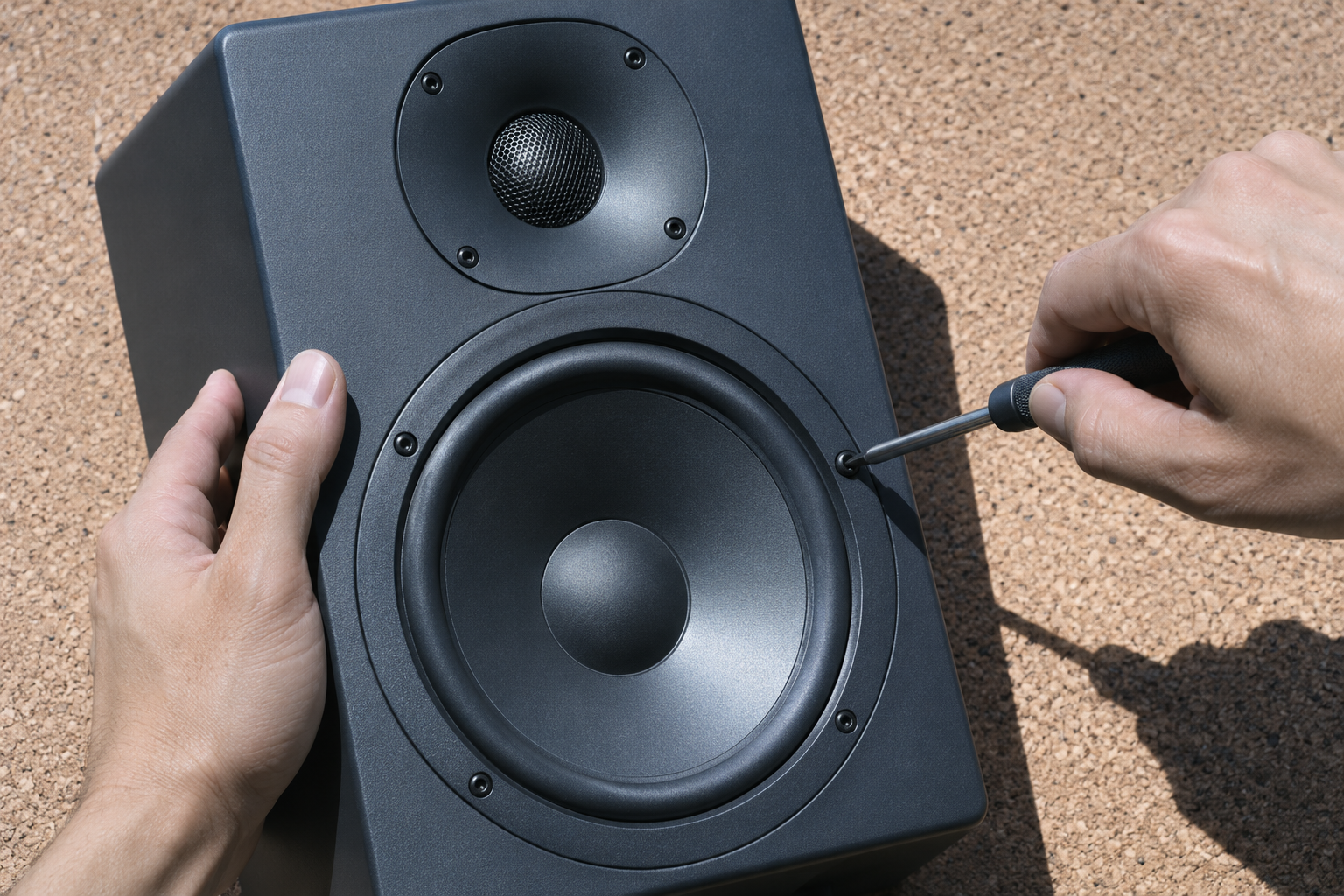
Two suites get installed into the same room, measured from the same seat, corrected against the same target, and then compared by ear over a week of real work. That’s the only way I trust a verdict on room correction software. Spec sheets and marketing curves tell you nothing about how the filters behave in a room with a genuine problem, like a 12 dB suck-out at 80 Hz that moves if you shift your head.
I ran both Sonarworks and Dirac Live on a room that is bad in the ordinary way: a small treated home studio with a low ceiling, a rear wall close behind the listening position, and a low-mid buildup that no amount of foam had touched. Both suites are commercial, both compute a correction filter from in-room measurements, and both claim to remove the room from the equation. The mechanics they use differ, and so does what you hear.
What each one actually does
Digital room correction as a field works the same way underneath: you measure the impulse response at the listening position, sometimes at several positions, the software computes a filter that inverts as much of the room and speaker response as it can, and the filter runs in real time on playback. Most systems use a swept sine as the test signal because it maximises signal-to-noise; the response is then deconvolved, smoothed, and a filter set is built to match a target curve. The delay and polarity corrections come out of the impulse response itself, which is why some suites report speaker distance in metres instead of milliseconds (that is simply delay multiplied by the speed of sound).
Where the two diverge is the philosophy of that inverse filter. A perfect inversion would only be valid at the exact microphone position; a few millimetres away the arrival times of reflections shift and the correction stops being accurate. Worse, aggressive acausal filters can introduce pre-echo, and an imperfectly corrected signal can sound worse than the raw room. Serious correction systems therefore favour a robust filter that works across a usable listening volume and avoids bad artifacts outside it, giving up some peak accuracy at the measurement seat to get there. Sonarworks and Dirac Live both make that trade; they make it differently.
Sonarworks leans on a reference target and a fairly constrained correction, tied to the idea of a neutral monitoring response rather than an exact inversion of your specific room. Dirac Live measures multiple positions, does more work in the time domain, and applies a mixed-phase correction that aims to fix the impulse response, not just the magnitude response. In practice that means Dirac is doing more processing and asking more of your setup at measurement time.
The measurement stage is where the two part company
Dirac’s multi-position sweep is the more demanding of the two. You place the mic at the main seat, then at several surrounding positions, and the software averages the impulse responses to build a correction that holds across a small area. That is exactly the robust approach the acoustics literature describes, and it is why Dirac tends to sound more stable when you move your head during a mix. It is also slower and more fiddly to set up, and if you get a position wrong the whole filter is compromised.
Sonarworks can run from a single position or a small multi-point set, and the single-seat route is quicker. The catch is the one any single-sweep correction carries: the filter is tuned to one point in space, and the moment you lean out of it, the correction is no longer what it was designed to be. For a solo engineer locked to one chair that is fine. For a room where a second person sits in on a session, it is a limitation.
What the correction actually sounds like
Both suites cleaned up the low-mid buildup in my room, and both tightened the bottom end. The difference was in the upper bass and the transition into the mids. Dirac’s time-domain work gave the kick and bass a definition that Sonarworks left slightly softer, and the stereo image was more solid across the seat. Sonarworks produced a correction that was easier to trust as neutral, because it changed less, and it did not introduce any audible pre-echo or phase weirdness in the vocal range.
Neither fixed the 80 Hz null. No correction software does, because a null is a cancellation and boosting it just loads the room harder. If your problem is a deep narrow dip, measure first and treat the room; the correction suite is not the tool for it.
Where each one is annoying
Dirac Live’s licensing is the thing that irritates me most. On PC it is a paid product, and on AVRs it appears only on select brands and often as an optional upgrade, which is a real cost if your receiver did not ship with it. The measurement process is fussy, and a bad mic position will quietly degrade your result. Sonarworks is simpler to run and easier to re-measure when you move a speaker, but that simplicity is the same reason it corrects less.
Both want a decent measurement microphone. A calibrated mic is not optional if you care about the result; an uncalibrated one bakes its own response into the correction.
How I’d choose
If your priority is a stable, time-corrected result across a small listening area, and you will put in the time on multi-position measurement, Dirac Live is the stronger tool. If you mix alone at one seat and want a neutral reference without a long setup, Sonarworks gets you there faster and changes less. Neither replaces acoustic treatment; they are the last step, not the first. Measure your room with a free tool like REW before you spend a penny on either suite, because the sweep will tell you whether the problem is fixable by correction at all, or whether it is a null that only moving the speakers or the seat will solve.