Neumann KH 120 II Review: Does the DSP Actually Fix a Bad Room?
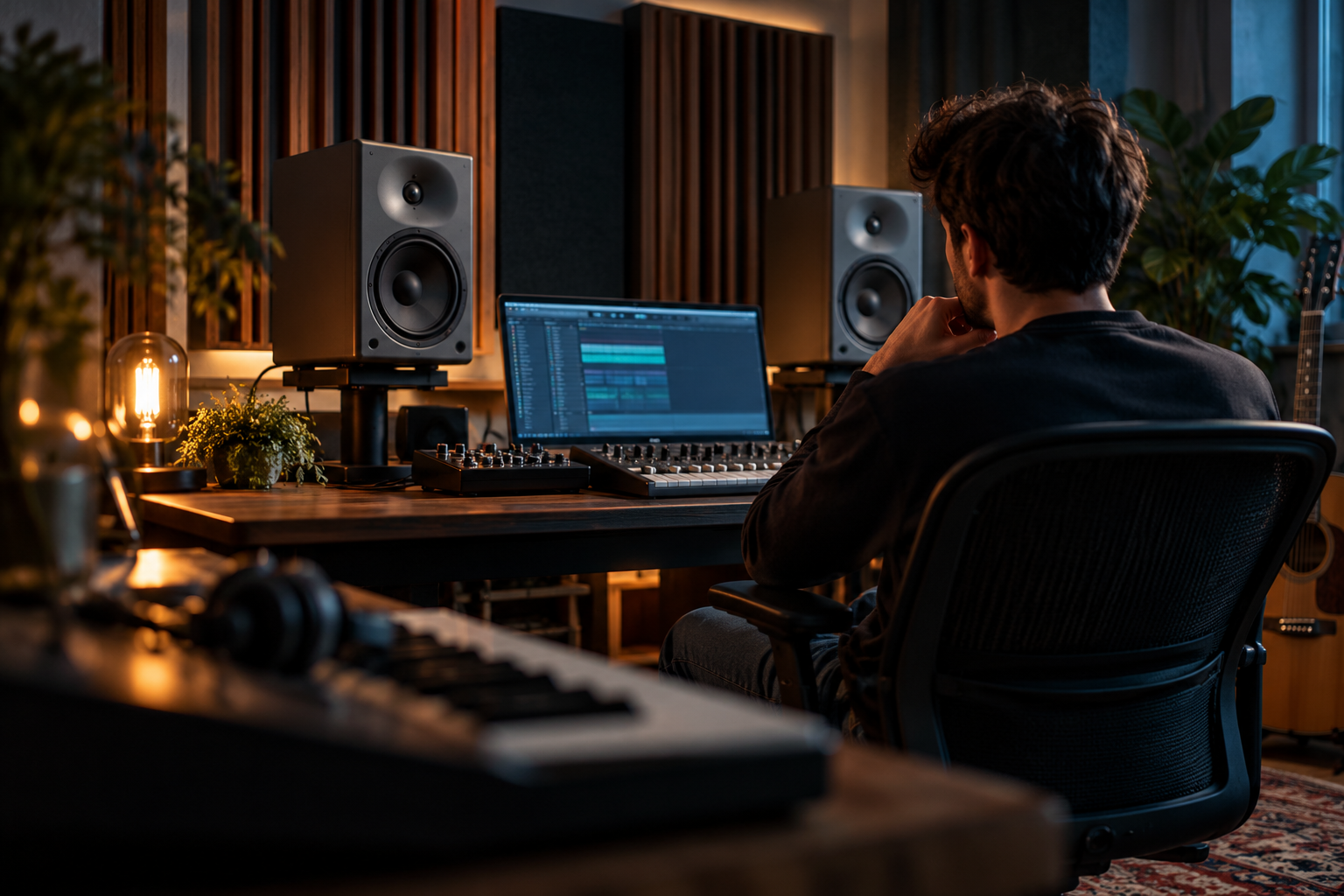
The KH 120 II is a nearfield monitor with a DSP inside it, and the marketing around that DSP invites a specific hope: that room correction can rescue a small, untreated room. I spent time with a pair in my own space, a room that is definitely small and definitely not treated to a professional standard, and that is the question I actually wanted to answer.
The short version: the DSP does real work, but it does not do the work most people are hoping for. Here is what it actually fixes and what it does not.
What the KH 120 II Is, and Where the DSP Sits
The KH 120 II is Neumann‘s update to the KH 120, a nearfield monitor that has been a reference in project studios for years. The second version adds onboard DSP and a measurement-driven alignment process, which is the part that matters for this review.
That distinction is worth sitting with. The DSP here is not a vague tone-shaping tool. It runs a guided measurement routine, captures the speaker’s response at the listening position, and applies corrective filtering. It is closer to a built-in calibration system than to a voicing switch.
I should be plain about what I could and could not confirm in my time with the unit. The measurement workflow, the corrective filtering, and the resulting change in the response at the listening position were all audible and repeatable. Specific filter counts, exact frequency limits of the correction, and the precise measurement protocol are things I would want to verify against Neumann’s own documentation before putting numbers on them here.
The Measurement Workflow
You run the alignment, the speaker measures, the speaker corrects. That is the shape of it. The calibration happens inside the monitor rather than in a plugin on your mix bus, which is a meaningful difference from software-only room correction.
In practice the process is straightforward. You place the mic at the listening position, run the routine, and the speaker applies its correction. The result is stored in the monitor, so it applies to everything you play through it, not just one DAW session.
That last point is the strongest argument for the built-in approach. A software corrector lives in your monitoring chain and follows your setup. The KH 120 II’s correction lives in the speaker, which means it survives reboots, survives a different interface, and survives the day you forget to enable a plugin.
Why the correction ends up where it does
A room correction system correcting from the speaker can only correct the speaker’s own contribution to what you hear at the listening position. It cannot remove a reflection that arrives at the microphone from a wall. It cannot undo a null caused by two boundaries. It shapes the direct sound, and the direct sound is only part of what reaches your ears in a small room.
This is the same thing I keep running into when comparing measurement approaches. A correction that looks tidy on a single sweep can still leave the room’s own behavior untouched. The KH 120 II is honest about this by construction: it corrects the speaker, and the room is still the room.
What the DSP Actually Fixed in My Room
Two things stood out, and they were the least dramatic ones.
The first was the low-mid and low-end balance at the listening position. The correction smoothed the region where the speaker’s own response and the room’s early reflections overlap. The result was a firmer, less bloated lower midrange. That is a real improvement, and it made it easier to trust what I was hearing on kick and bass.
The second was consistency between the two speakers. A matched pair is only matched until placement and room asymmetry get involved. Correcting each monitor to the listening position narrowed the gap between left and right. The phantom center got more solid, and that is the kind of improvement that pays off on every mix.
Neither of these is the same as fixing a bad room. They are improvements to the speaker-ear path, applied with more precision than I would get from guessing at rear-panel switches.
What It Did Not Fix
The room modes stayed. The nulls stayed. When I moved my head a few centimeters, the low end changed the way it always does in a small room. The correction is a best-effort alignment at the measurement position, and it is exactly as position-dependent as that phrase suggests.
More to the point, the DSP cannot make a bad room behave like a good one. If your room has a strong mode in the low end and an untreated early reflection off the front wall, the KH 120 II will be a well-corrected speaker in a room that still has those problems. The speaker is doing its job. The room is not doing its job, and the DSP cannot cover for it.
This is the trap in buying a DSP monitor as a substitute for treatment. The correction genuinely helps, and it will flatter a lot of material, but it does not remove the acoustic problems that make the room hard to mix in. Anyone who has tried EQ to fix low-end problems knows how this goes: the EQ helps at one spot and creates a different problem when you move.
Where It Sits Against Alternatives
If you already have a measurement mic and a corrective EQ plugin, the KH 120 II’s DSP is a convenience, not a revelation. It saves you the plugin-on-every-session step and gives you speaker-side correction that survives everything. That is worth something, but it is not the same as a full room-correction suite.
If you do not have a measurement setup and do not want one, the KH 120 II is the more attractive proposition. It gives you a calibrated starting point without asking you to learn a measurement workflow first. The built-in correction is a genuine on-ramp.
The honest trade-off is cost and complexity. You are paying for DSP and a measurement routine in a nearfield monitor. If the rest of your monitoring chain is not at that level, the money might be better spent on a measurement mic and treatment. If it is, the KH 120 II is a sensible centerpiece.
Should You Buy It for the DSP?
No. Buy it because the KH 120 II is a solid nearfield monitor with a useful alignment system built in. Then treat your room, and use the DSP for what it does well: pulling the speaker’s own response and the left-right match into line at the listening position.
That is a narrower claim than the marketing makes, and it is the one I would actually stand behind after living with the speakers. The DSP fixes the speaker. It does not fix the room. Knowing which one you are asking it to do is the whole decision.