Bass traps versus EQ below 200 Hz: what each one actually fixed
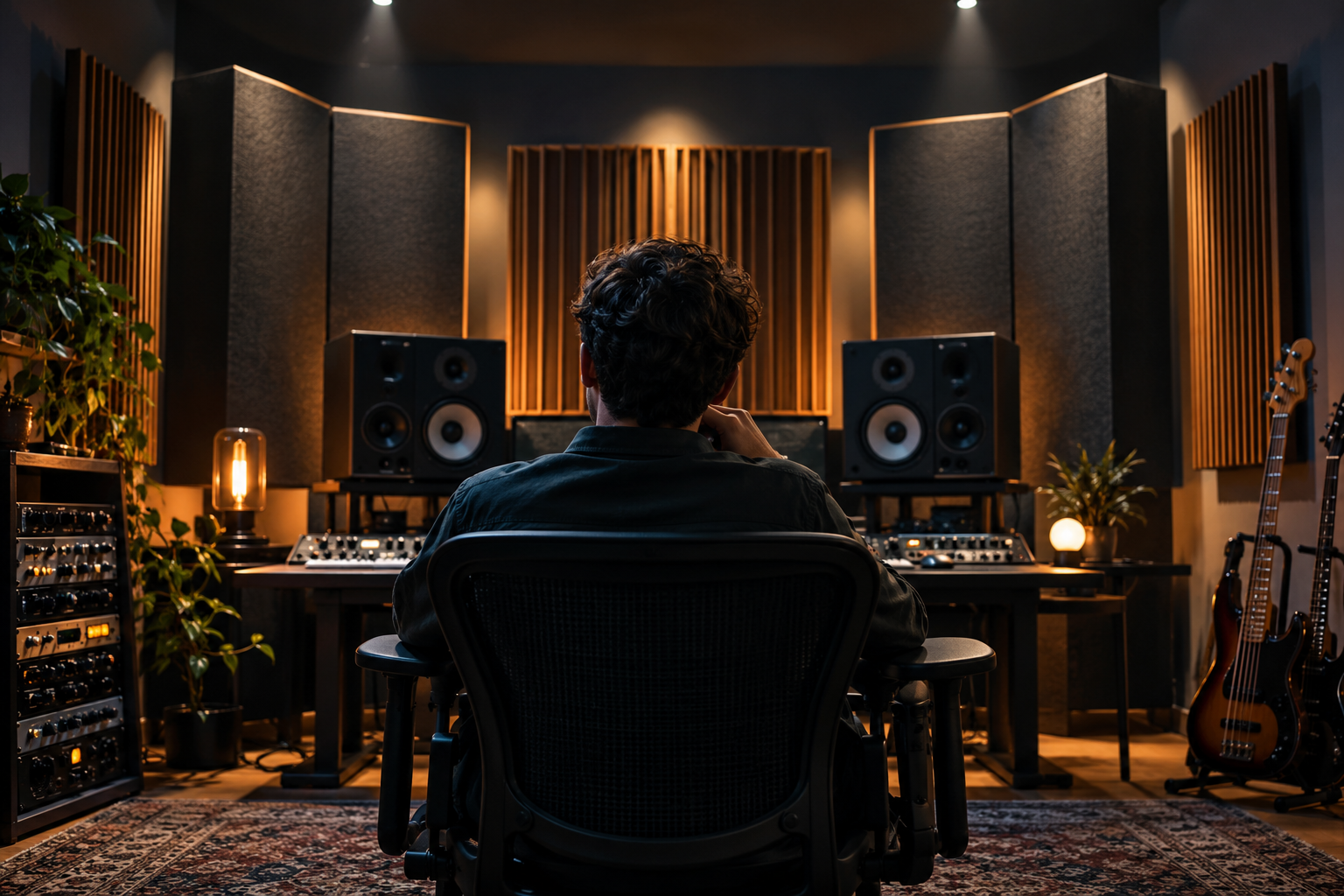
The first time I put a measurement mic in a real room and looked at the decay time below 200 Hz, I stopped trusting my EQ. The response curve on the screen looked fixable. A cut here, a narrow notch there, and the boom was gone. Then I moved the mic 40 cm to the left and the boom was back at a different frequency. That is the whole argument in one gesture: below 200 Hz you are fighting room geometry, not a tonal imbalance, and a parametric EQ does not know the difference.
I have done it both ways. I still do. Below is what each tool actually fixed in my room, and where each one made things worse.
What a bass trap fixes that EQ cannot
Modal ringing. That is the honest answer. A room’s low-frequency modes store energy. When the source stops, the mode keeps ringing, and its decay time can be several times longer than the rest of the spectrum. You hear it as smeared, one-note bass, and no filter removes it, because the filter only shapes what goes into the room. The mode keeps ringing on the way out.
A trap absorbs that energy at the boundary. Once the decay is shortened, the notes separate. Kick and bass line up. Before the traps I could not tell a 55 Hz note from a 58 Hz note on the same bass patch. After, I could. That is not a frequency response change. That is a time-domain change, and EQ cannot touch it.
The second thing traps fix is placement drift. My worst mode peaked sharply depending on where I sat. A 6 dB cut at 60 Hz at the listening position turned into a 3 dB boost at the desk behind me. Traps raise the floor everywhere because they reduce the stored energy that creates the mode in the first place. The curve flattens in the room, not just at one point. If you mix for anyone other than yourself, this is the argument that matters.
The third thing, less talked about: traps reduce the amount of low end leaking into the rest of the house. My neighbours noticed before I finished installing them. Absorption is absorption.
What EQ below 200 Hz actually does well
It trims excess. Broad, gentle shelves and low cuts. Room gain humps, the low-end rise that a corner-loaded speaker produces, a shelf at 120 to 150 Hz that takes 2 to 3 dB off without touching the modes. If a mode sits below the room’s usable range, a high-pass at 35 to 40 Hz removes signal the driver cannot reproduce anyway.
Narrow cuts can work too, but only under two conditions. First, the cut is at exactly the right frequency. Second, the cut is measured at the listening position, not guessed. The moment you move, the cut stops matching the mode. In my log, every narrow notch I placed by ear was off by at least 20 Hz and made the neighbouring mode louder.
I use a dynamic EQ for low-end cleanup. A band that only reacts when the signal crosses a threshold, like the TDR Nova band behaviour described in free plugin roundups, is far gentler on musical material than a static cut. Static correction below 200 Hz is a broad problem, and static EQ is a blunt instrument. Dynamic EQ at least waits for the problem to show up.
Where each one failed in my room
Bass traps failed at fixing a speaker’s own response. My monitors had a pronounced dip around 200 Hz, the lower-mid range hollow you see in headphone charts too, and no amount of corner absorption closed it. That dip is a speaker and placement issue, and EQ is a reasonable place to shave the resulting bump once the modes are controlled. Traps made the room more honest, which made the speaker flaw more obvious.
EQ failed at everything time-related. It also failed at adding clarity. Cutting a ring frequency makes the boom quieter but leaves the smeared decay in place. The mix sounds dull after the cut rather than tight. I have also watched a mixer stack five narrow cuts between 40 and 90 Hz chasing a moving target. The result was a thin, phase-smeared kick with a hole that moved with the chair. Stop after two notches.
One more flaw worth naming: a strong cut below 100 Hz reduces amplifier headroom demand, so you get louder bass readings on the meter while the room still rings. A trap does the opposite. It costs you no level and shortens the ring.
Practical order of operations
Measure first, with a calibrated mic and a decay plot, not only a response curve. If the waterfall shows energy hanging below 200 Hz, traps come first. Treat the corners and the first reflection points for the low band and let the decay times settle within the room’s natural spread.
Then remeasure. The remaining low-frequency deviations are usually broad and gentle, and a shelf plus a low cut handles them. Keep the cut narrow only when the mode is narrow and you have verified it at the listening position. If a plugin chain is part of your monitoring path, put a dynamic EQ there and let it catch resonances rather than correct the room. Static correction stays in the monitor controller, not the master bus.
If the budget is tight, spend it on the treatment. One well-placed trap below 100 Hz fixes more than a dozen notches. If the room is already treated and the curve still has a shelf somewhere between 100 and 200 Hz, reach for the EQ. That is the split. Traps fix time. EQ fixes level. Confusing the two is why so many rooms sound boomy and thin at once.