Speaker Placement Before Room Treatment: What to Fix First With a Measurement Mic
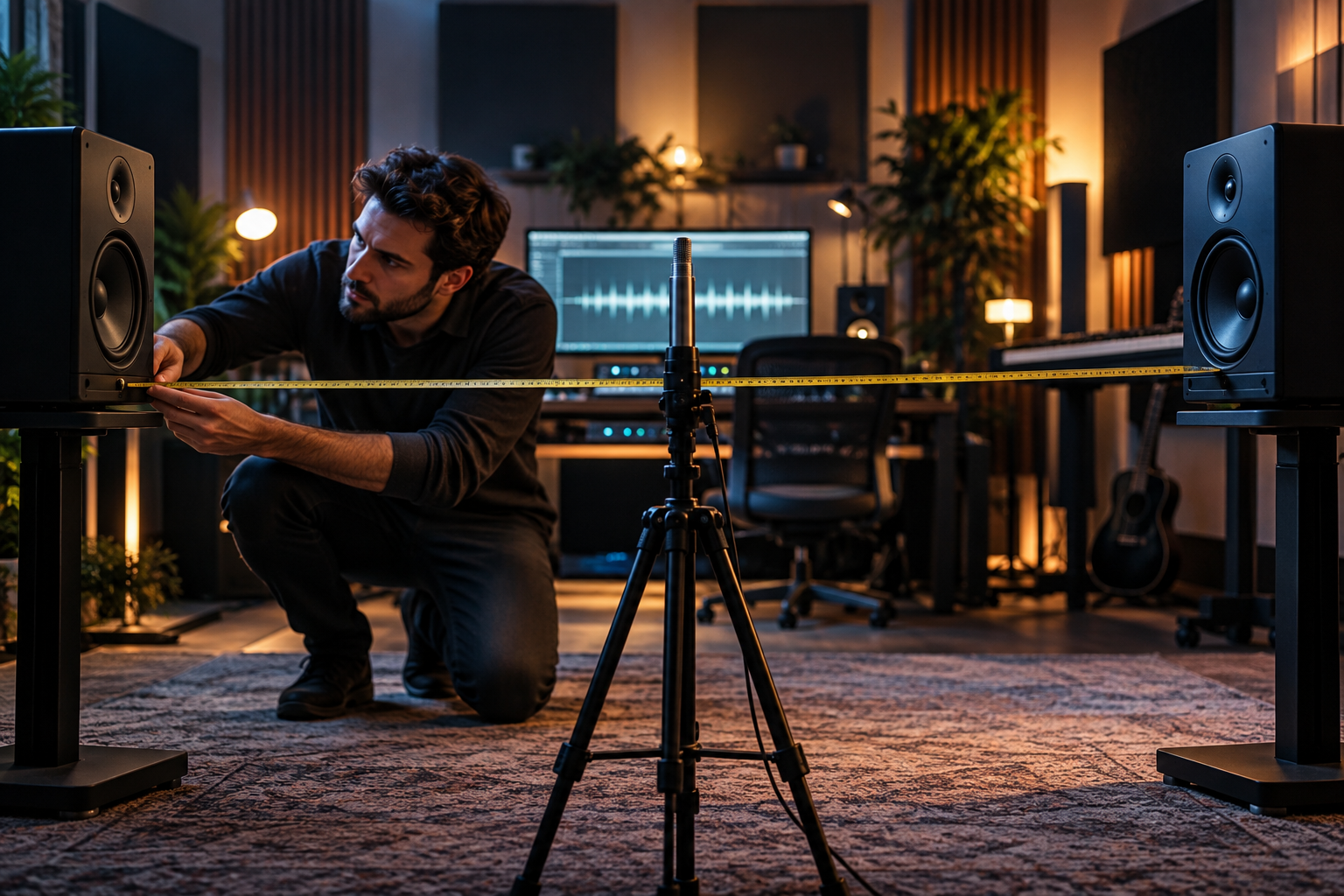
Before you buy a single bass trap, move the speakers. I know that sounds backwards. The reflex is to treat the room first, because the room is the problem, right? But a measurement mic will show you something uncomfortable: half the mess in a small room is the geometry between the speakers and the walls, and no amount of foam fixes a null that exists because the woofer is sitting at a quarter-wavelength from the front wall.
So here is the order I actually work in, and why a mic earns its place before the credit card comes out for treatment.
Why placement comes first
Room correction software, the kind that measures an impulse response at the listening position and computes an inverse filter, can do a lot. Modern systems produce real improvements in both the time and frequency domain [3]. But they cannot move a speaker. And a filter that flattens a null at the mic only works at that exact spot: a few millimetres away, the arrival times from the various reflections shift and the inversion falls apart [5].
That is the whole argument in one paragraph. If you EQ or treat around a bad placement, you are polishing a compromise that is only valid in one seat. Move the speaker, and the problem changes at the source.
Get the mic and the sweep running first
You do not need expensive software to start. REW (Room EQ Wizard) is free and does SPL, phase, decay, waterfall, spectrogram, RT60, distortion and clarity views, plus impulse response windowing and a room simulator for subwoofer placement [2]. That room simulator is the underrated part: you can model sub positions before you drag anything across the floor.
The test signal that matters here is a swept sine, or chirp. It maximises the measurement’s signal-to-noise ratio, and the spectrum comes out by deconvolution, dividing the response’s Fourier transform by the signal’s [1]. In plain terms: a clean sweep, a quiet room, and you get a trustworthy picture of what the speakers are doing.
Keep the mic fixed. One seat, one sweep, then change one variable. That is the entire method.
The three placement moves that fix the most
1. Distance to the front wall
This is the first thing I sweep. Pull the speakers well clear of the wall in front of them and the boundary cancellation moves down and out of the way of the low mids. Push them back into the wall and it climbs right into the vocal range. Every small-room mix where the low end feels thin but the meters say otherwise usually traces back to this.
Sweep the distance in steps, re-measure, watch where the dip lands. Pick the distance that puts the dip where you can live with it. No EQ required yet.
2. Symmetry left to right
An asymmetric setup, one speaker near a side wall and one near a doorway, gives you two different rooms for two channels. The mic will show it as mismatched low-frequency behaviour between left and right. Fix the geometry before you touch correction, because a room correction filter computed per-channel will try to compensate for a problem that is really just furniture.
3. Listening distance and the equilateral triangle
Nearfields are called nearfields for a reason. Sit closer and you hear more direct sound and less room. Pull back and the reflected energy climbs. I measure at two or three listening distances and keep the one where the response is flattest before any processing. It is usually closer than feels natural at first.
What the mic is actually telling you
Run the sweep and look at the impulse response, not just the frequency curve. The impulse peak’s distance from the start of the signal is the delay, and its sign is the polarity [1]. DRC tools correct delay by subtracting each channel’s delay from the system peak delay and applying the difference as added delay [5]. Some report this back to you as a distance from the speaker, computed by multiplying delay by the speed of sound.
That distance readout is a sanity check on your placement. If the software thinks one speaker is dramatically further away than your tape measure says, you have a reflection arriving early enough to fool the peak detection, and that is a placement and treatment problem, not an EQ problem.
One caution on polarity. If the tool flags a channel as inverted, check the wiring before believing it. A swapped + and – is the usual cause, fixable by flipping the wire or multiplying each sample by -1. But some speakers invert intentionally, Focal Kanta among them, so the software shows it as a warning rather than forcing a fix [5].
Where correction and treatment come in, and where they don’t
Once placement is settled, then you measure for real and decide what the remaining problems are. Correction systems are not built to perfectly invert the room. A perfect inversion is only valid at the measurement point, and the acausal filters involved can introduce pre-echo that sounds worse than the uncorrected signal [5]. Good correction software therefore aims for a robust inverse that works over a usable volume rather than peak accuracy in one spot [2][5].
That is exactly why placement has to come first. You are giving the correction a better starting point so it has less to fight. Same logic for treatment: a bass trap does more once the speaker is not already firing a cancellation into the seat.
If you want to go deeper into filter work later, the free tools are genuinely capable. RePhase generates EQ and crossover sets and linearises phase response, exporting a single FIR impulse [2]. Cavern QuickEQ handles multichannel measurement with multiple mics, time and level alignment across several target curves, and exports minimum- or zero-phase FIR or peaking EQs [2]. None of that replaces moving the box.
A practical order of operations
- Set up the measurement mic at the seat. Run one sweep, learn the software, ignore the result.
- Sweep front-wall distance. Note where the low-mid dip sits. Choose your compromise.
- Fix left-right symmetry. Move furniture, not filters.
- Test two or three listening distances. Keep the flattest.
- Re-measure. Now you know what is actually left to fix.
- Only now consider EQ or correction, and only for what placement could not solve.
- Treat the room last, guided by the measurements, not by a forum thread.
The mic does not cost much and the sweep is free. Spending an afternoon on geometry before you spend a penny on treatment is the highest-return move in a small room. The measurements will tell you the rest, and they will tell you honestly, which is more than a product page ever will.