What a spatial average hides, and when a single-seat sweep is the right answer
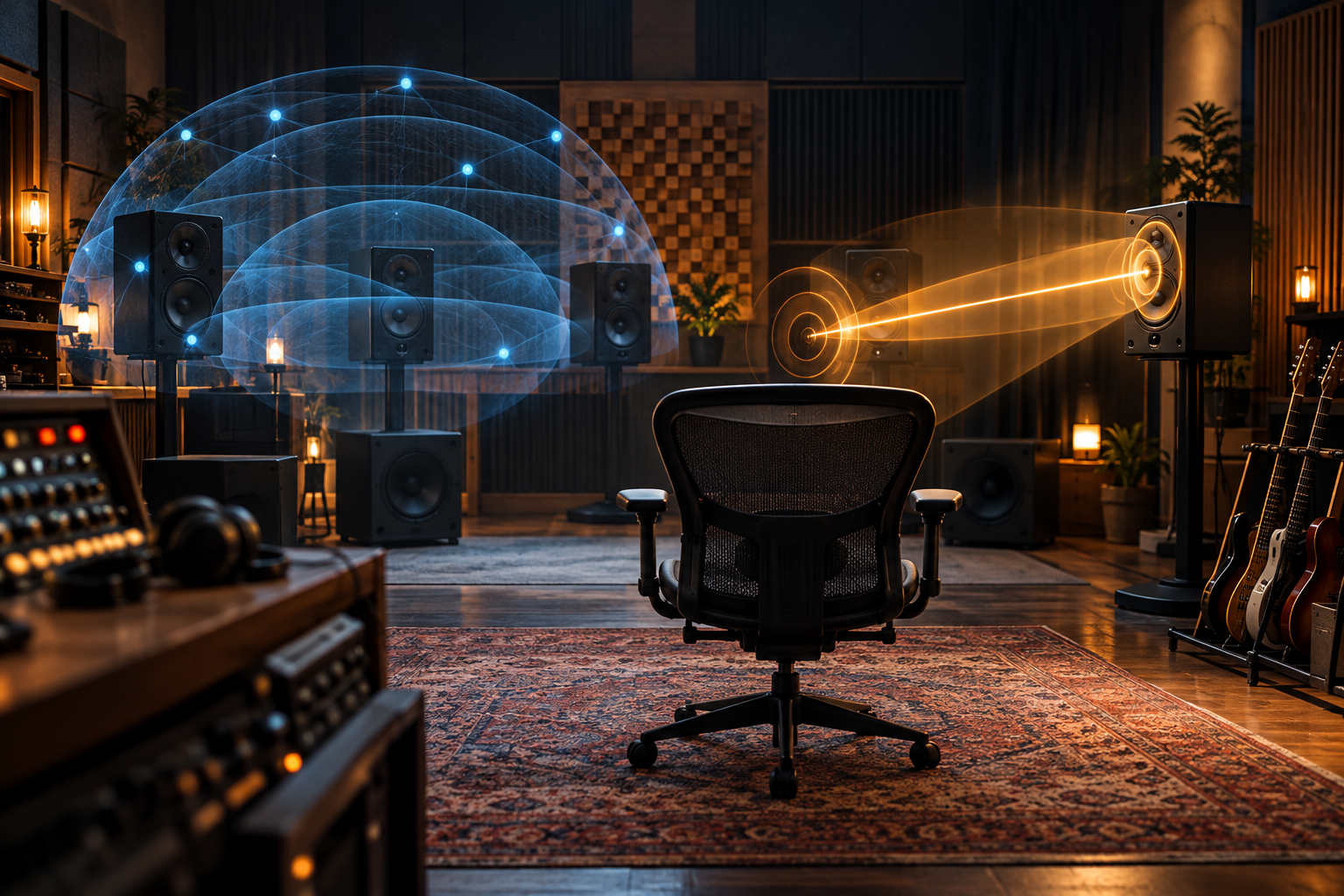
Last week I re-measured a room I’d already treated and got two numbers that disagreed by almost 8 dB at 63 Hz. Same mic, same interface, ten minutes apart. The only thing that changed was the sweep method: a 9-point spatial average versus a single sweep at the client’s actual chair.
That gap is the whole story. Every measurement tool I use, REW as a delivery vehicle, but the principle holds whether it’s SMAART, ARTA, or a Trinnov rig, will happily hand you a spatially averaged response and a single-position curve, and they look like two versions of the same fact. They aren’t. One describes the room as a volume. The other describes what one pair of ears will hear. Picking wrong means treating a problem that doesn’t exist, or missing one that does.
What averaging actually does to your data
A spatial average is a mean, and means lie by flattening. Park the mic at nine positions around a listening area, let the software average the complex or magnitude responses, and what comes out is a curve that no human will ever sit inside.
Here’s the mechanism, and it’s the same one that bites people in low-frequency room analysis. Below the Schroeder frequency, a normal domestic room is a modal field: discrete, high-Q resonances at specific positions. At a peak, the pressure doubles relative to a null a half-wavelength away. Average enough points across that standing wave and the peaks and dips partially cancel each other. The averaged curve looks smoother and tamer than reality. You didn’t fix the mode. You hid it.
That matters because a perfectly diffusive space, where the reverberation time is identical at every seat, basically doesn’t exist in a residential room. Most interiors are non-diffusive and reverberation time swings considerably around the room (that’s straight out of the architectural acoustics literature, and it matches everything I’ve measured). Averaging assumes the field is roughly uniform. It isn’t. So the average is a statistical artifact of the sampling pattern, and change your mic count from 6 to 15 and the answer moves.
When a single-seat sweep is the right instrument
Most of my work is one listener in one chair. Stereo, maybe a sub, maybe two if the client insists. In that situation a single sweep at ear height, at the actual seated position, is not a compromise. It is the correct measurement.
- The seat is the system. If a 52 Hz null is 400 mm wide and your head is in it, your head is in it. Averaging across the sofa removes the null from the plot but not from your experience.
- Sub integration needs the worst-case curve. I align sub phase and delay against the single-seat response because that’s where the crossover cancellation will actually bite. An averaged plot smears the phase relationship I’m trying to correct.
- You catch position-sensitive problems. A single-seat sweep shows the sharp, ugly, narrow-band stuff that means “move the speaker 30 cm.” The average shows a gentle slope that means “buy a bass trap” and may be entirely wrong.
One companion got annoyed watching me re-sweep the same chair eight times during a sub integration. But every one of those sweeps was a decision: phase, polarity, crossover point. None of them would have been visible in an averaged curve. This is where the single-seat measurement earns its keep, and it’s the same logic that separates room correction from actual acoustic treatment, which I went through in the bass trap versus EQ piece and won’t relitigate here.
Where averaging is genuinely the right call
Spatial averaging isn’t a mistake, it’s just answering a different question. Use it when the question is “what does this room broadly sound like,” not “what will my client hear.”
Concretely: broad tonal balance above ~300 Hz, checking whether a treatment plan improved the whole room and not just one spot, and documenting a multi-seat home theater where five people actually listen. In a true multi-row room the average has a real physical meaning because you genuinely care about the aggregate, and you’ll want per-row sweeps in addition to know the spread.
Also, and this is the point most people miss: averaging multiple positions is how you distinguish a fixable reflection from a modal nightmare. If a dip persists across every position, it’s probably a reflection or crossover cancellation you can address. If it appears at one mic position and vanishes at the next, it’s a local mode, and moving the mic or the speaker is the answer, not a panel.
Making the two numbers talk
Here’s what I actually do, and it takes maybe fifteen minutes.
- Single seat first, at ear height, three sweeps, keep the best S/N. Treat this as the reference. This is the curve I optimize against.
- Then a 6-point spatial average around the listening area, roughly 300 mm apart. Not to fix anything, but to see how badly the seat deviates from its neighbors, i.e., how positionally sensitive the room is.
- Overlay them. Where they agree, the problem is real and global. Where the single-seat curve has a spike the average doesn’t, that’s a local mode, and my decision is “move the sub” rather than “EQ it out.”
This is the same instinct as using both a wideband RT60 number and third-octave band RT60. Wideband tells you if the room is lively overall; third-octave tells you whether the 125 Hz band is the reason the bass feels slow. A single number is convenient, and sometimes misleading. Get the band data before making a decision, and get the position data before making a decision, and don’t confuse a convenient summary with the underlying measurement.
One more caveat I’ve learned the hard way: display smoothing destroys the comparison. If you view the averaged curve at 1/3-octave and the single-seat at 1/48-octave, you’ll conclude the room got smoother than it did. Compare at identical resolution, raw, and let the ugly show. Then smooth for presentation only.
The verdict
A spatial average is a statement about a volume. A single-seat sweep is a statement about a person. If someone actually sits in a specific chair and listens to music, measure that chair. Use the average as a diagnostic companion to tell you whether the problem is global or local, and to document the room for the record, and use it to check broad tonal balance, but do not tune the system to a curve that no one will sit inside. The 8 dB disagreement at 63 Hz was the average lying about a null I could plainly hear. Trust the seat.