Measuring a room before specifying anything: five mic positions, one honest average
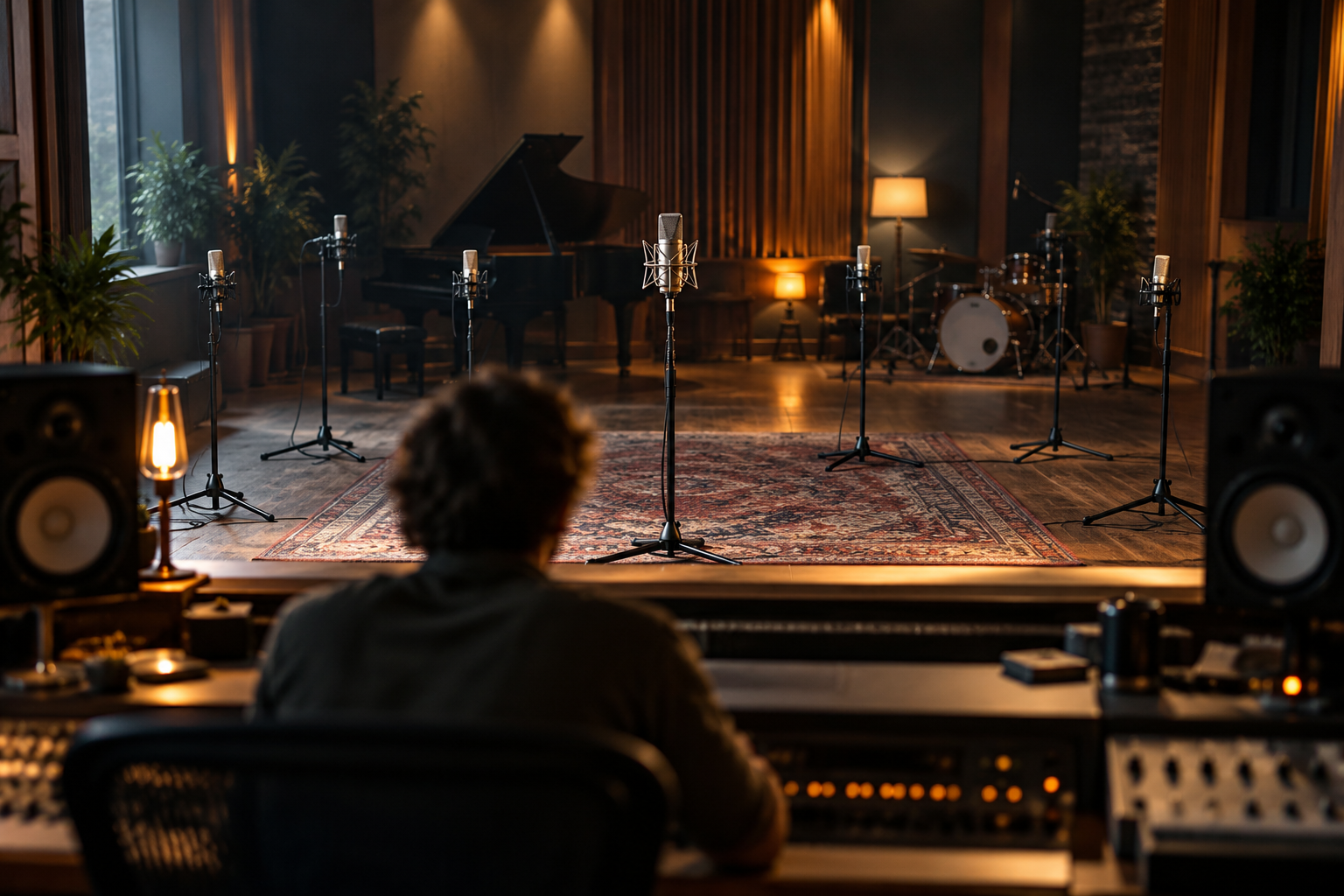
The first room measurement I do on any job decides what gear I even bother quoting. Not because the sweep is gospel, but because it tells me where the problem lives before I start spending someone else’s money. Five positions, averaged, saved as a reference file. That’s the whole method. Everything after it is just reading the graph honestly.
I’ve watched installers skip this step, spec a £4k amplifier, and then fight a 12 dB suck-out at 60 Hz for two days. The measurement would have shown it in four minutes. This is the routine I run, why five positions and not one, and where the average will lie to you if you let it.
Why an average, and why five
A single sweep at the listening seat shows you exactly that: one point in space. Move your head 30 cm and the low end can change by 10 dB. That’s not a fault in the room, it’s how standing waves work. Peaks and nulls sit at fixed locations, and your ears don’t live at a fixed location.
So I take five sweeps and average them. Not because the average is the truth, but because it’s the closest thing to what a listener actually hears over a few minutes of moving around. Five is the practical minimum that still smooths out the worst position-specific artefacts without burying the real modes. Three leaves too much of one seat’s signature in the result. Eight is a waste of an afternoon for a room you’re about to treat anyway.
The average doesn’t replace a single-seat sweep. It answers a different question. If the client cares about one chair, measure the one chair. But for specifying treatment and checking whether a sub is integrated, I want the spatial picture first.
The five positions I actually use
Picture the listening triangle. My five mic spots:
- Seat centre. Ear height, exactly where the head goes. This is the anchor.
- 20 cm forward of centre. Catches the null that sits just in front of the head.
- 20 cm behind centre. Same idea, other direction. The peaks behind the ears are often the loudest thing in the room.
- 40 cm to the left, ear height. Off-axis, on the diagonal of the room if the room is symmetric.
- 40 cm to the right, ear height. Mirror of the last one.
Keep the mic capsule at the same height for all five. I use a laser level or a pencil mark on a stand. A 5 cm height error shows up as a tilt above 2 kHz and you’ll blame the tweeter.
The exact numbers aren’t sacred. What matters is that the offsets are large enough to move you out of one standing wave’s grip but small enough to stay inside a realistic listening zone. 20 to 40 cm does that.
The mic, the interface, and the bits people get wrong
You don’t need a measurement mic with a calibration file to make specification decisions, though it helps. A calibration file corrects mic-to-mic variation, typically a couple of dB at the extremes. Without one, your absolute level above 10 kHz and below 40 Hz is approximate. For relative comparisons (before and after treatment), it barely matters.
What does matter: consistent gain and a quiet room. Set input gain so peaks don’t clip, but don’t touch it between the five sweeps. If you change gain mid-set, your average is garbage. Same principle as any A/B test: hold everything constant except the variable.
The other constant is the room itself. Turn off the HVAC, the fridge, the washing machine next door. Close the windows. Note anything you can’t turn off and measure anyway, but write it down. A fan at 50 Hz will sit right in your average and you’ll spend a week trying to trap it.
Sweep length matters less than people think. A short swept sine is fine for the 40 Hz to 400 Hz region that drives most specification decisions. For anything below 40 Hz, longer sweeps and more averages reduce noise. If your tool lets you stack averages, do it.
Read the average before you read the peak
Here’s the part I see skipped. People pull up the averaged response, spot a 15 dB peak at 45 Hz, and order a bass trap. Then they treat the corner, measure again, and the peak moved or split. Why? Because the average was hiding the fact that the peak lived in one seat and the null lived in the next.
Look at the five individual sweeps first. Compare them. If all five agree there’s a peak at 45 Hz, that’s a room mode, and treatment is the honest fix. If position 1 has a peak and position 3 has a null at the same frequency, that’s a standing wave and you need to decide which seat matters.
Only after that do I look at the average and set the specification: where treatment goes, whether a sub will help, whether a room correction filter is even worth the hassle. The average tells me the target. The individual sweeps tell me the mechanism.
What the average can’t tell you
It lies about time. A frequency response curve says nothing about decay. A room can have a nearly flat average and still ring like a bell at 80 Hz. If the decay is long, the average looks fine and the bass still sounds slow and boomy.
So after the five-position average, I run a decay measurement (waterfall or spectrogram, whichever the tool gives me) at the centre seat. Usually one spot is enough for decay; decay is more position-stable than the response curve. If the ring is long, that’s what I specify treatment for, not the flat-looking average.
The average also can’t tell you about the loudspeaker. A dip at 2 kHz in the average might be the room, or it might be a crossover issue in the speaker. Measure one speaker at one metre on axis, free of the room as far as you can, to get the speaker’s own signature out of the way. Then measure both in the room.
And it can’t fix the source. Terrible room acoustics will still wreck a recording regardless of how honest your microphone comparison is. Same principle applies on the playback side. If the room is badly treated, no amount of specification precision saves you. Get the measurement, then fix the room first.
The reference file is the deliverable
Save the five-sweep average as a reference file and name it with the date and the mic position set. Every future change to the room gets measured against it. New treatment? Measure. New furniture? Measure. That reference is worth more than any single graph, because it’s the only way to know whether your changes actually did anything.
That’s the whole routine. Five positions, averaged, then read honestly. The specification writes itself once you stop pretending the average is the whole story.