Why Your Mixes Sound Thin on Car Speakers: A Practical Monitoring Fix
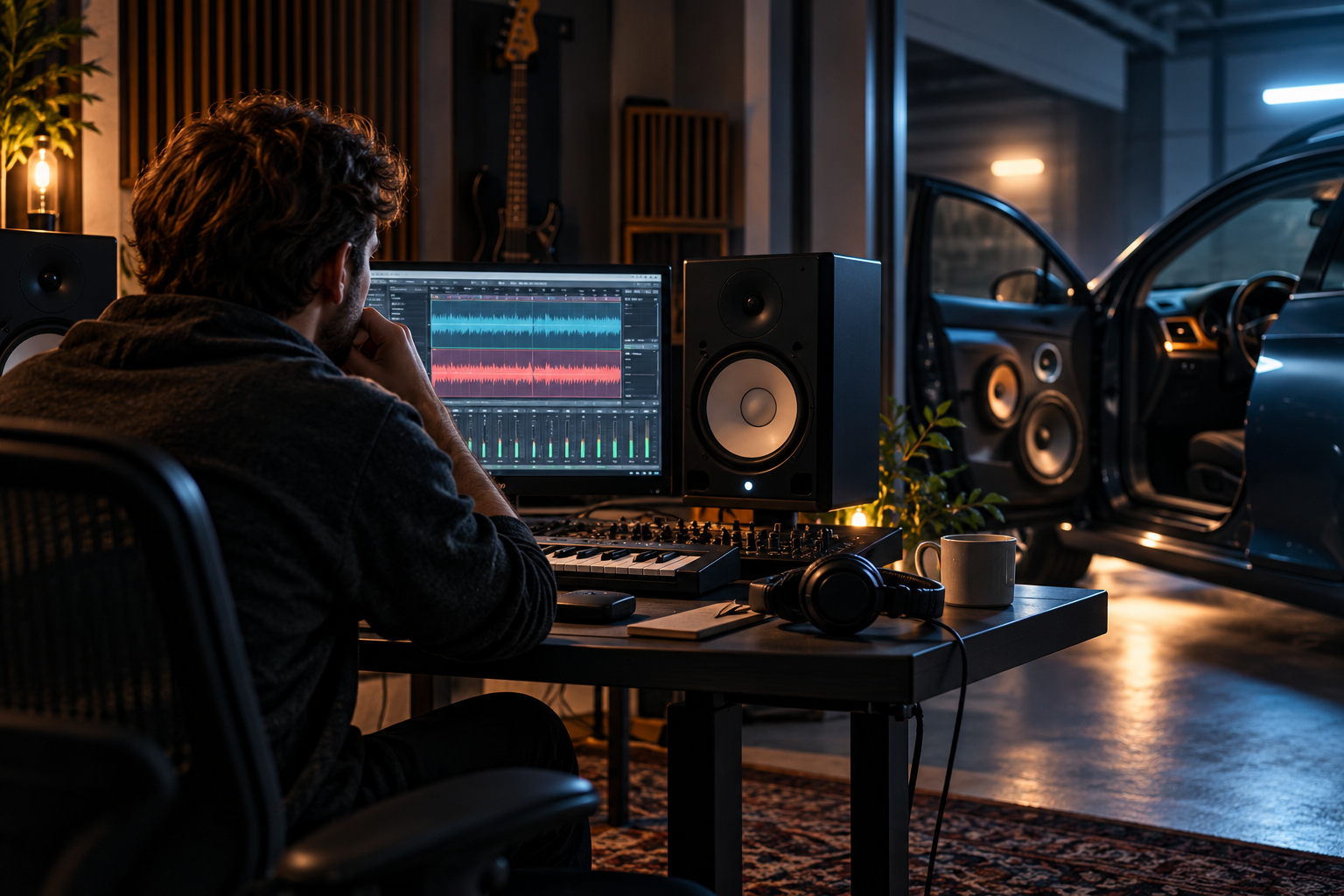
Every car test I have ever done on a mix I was proud of has been humbling in the same way. It sounds full and correct on the nearfields. On headphones it still holds together. Then I burn a reference CD (or, more honestly, AirDrop an MP3 to my phone), start the engine, pull out of the driveway, and the low end evaporates. The kick has no weight. The bass line is a rumor. The whole mix sounds like it was recorded through a paper towel tube.
This is the most reported monitoring problem in small-studio work, and the diagnosis is usually not “my car speakers are bad” or “my master is wrong.” It is that the room I mixed in and the car are making opposite lies about the same music. Fixing it is less about plugins and more about learning what your specific monitoring chain is hiding.
Why the car exposes what nearfields flatter
Two things are happening at once, and it helps to separate them.
The first is acoustic. A small untreated room has room modes at low frequencies, and those modes are peaky and uneven. A mode doesn’t add bass: it adds bass at certain notes and removes it at others. You mix to what you hear. If your room has a null around 60 Hz, you will push the kick and bass until they feel right in the room, and on a system without that null they will be bloated. If your room has a peak there, you will pull them back and the car, with its own different loading, will sound thin by comparison. Either way you are mixing toward a room artifact, not toward the music.
The second is arrangement and phase. This is the one that gets skipped. As the folks at Major Mixing put it, the “sounds fine in headphones and wrong in the car” complaint is “almost always a low-end problem, and almost always a problem of arrangement rather than level.” The kick and the bass are occupying the same fundamental, the phase relationship between them shifts with the playback system, and one room hides the conflict while another exposes it. No EQ curve at the master stage will separate two sounds that were never separated in the arrangement.
That reframes the whole problem. The car isn’t wrong. It’s a second, very different room, and it’s telling you something your room was hiding.
The car is not a reference, it’s a stress test
I want to be careful here, because the instinct is to drive around until the mix sounds good in the car and call it done. That is how you end up with a mix that only works in one car.
Car cabins are their own acoustic environment: small volume, lots of glass and plastic, a listening position that is off-center for the driver, and a stereo image that gets mangled by reflections off the windshield. A car is a useful translation check, not a mastering reference. Treating a car system as ground truth is how you over-correct.
What the car is genuinely good at is revealing low-end problems that a small room masks, and revealing mono-collapse problems in the mid and side content. What it is bad at is telling you how much bass is “right,” because the car’s own transfer function is unfamiliar and inconsistent between vehicles. I have a reference track I know cold, and I always play it before my own mix in any car. That gives me a moving baseline. Without it, I’m just guessing in a different room.
What a measurement actually buys you
The first thing I do when a mix feels thin in the car is stop reaching for an EQ and start asking whether my room is lying to me at low frequencies. This is where measurement earns its place. A single sweep at the listening position, or better, a handful of positions averaged, shows you where your room peaks and dips below about 300 Hz. That number is the whole game. If there is a 10 dB null at 70 Hz, you now know why your kick felt weak in the room and why you compensated by pushing it too hard.
The caveat, and I’ve written about this before, is that a single-seat sweep and a spatial average tell different stories. For a one-person mix position, a careful single-seat measurement is often the more actionable number. Averaging across several positions can smooth away the exact null that is wrecking your kick. Measure where your head actually is.
Fix the room before you fix the mix
Once you know where the room peaks and dips, the temptation is to draw an EQ curve and call it calibration. I’d push back on that for the low end. Corrective EQ can flatten a peak to some degree, but it cannot fill a null, because a null is a cancellation, and adding energy at that frequency just feeds the cancellation. Bass traps address the mode at its source. They are slower, uglier, and more expensive than a plugin, but below 200 Hz they do something EQ cannot.
Practically: measure first, treat the obvious problems, then measure again, and only then decide whether a corrective EQ is doing anything useful or just masking the room. This is the same workflow I use for any small-room monitoring problem, and it is the reason I keep a measurement mic and a reference track in the same drawer.
The monitoring plugins worth using, and what they don’t do
Here’s the honest part. Monitoring and corrective EQ plugins are genuinely useful, but they are not a substitute for knowing your room. A good room-correction plugin, fed a proper measurement, can flatten the peaks and get your monitoring closer to neutral. That is a real improvement, and I use one on my mix bus for exactly that reason.
What it will not do is fix a null, undo a bad arrangement decision, or make your car sound like your studio. Any tool that claims to make a mix “translate” is really just giving you a more neutral monitoring environment to make better decisions in. The decisions are still yours.
I also keep a mono-check handy, because the car often reveals mid and side problems that stereo monitoring hides. Side-heavy processing that sounds wide on nearfields can collapse to a hollow, phasey center in mono, which is closer to how a lot of real-world playback (phones, small speakers, some car systems) behaves. Transpanner-style HRTF tools are a different beast entirely: they use crosstalk cancellation and head-related transfer functions to place sounds outside the speaker cone, and they are not a translation fix. Treat them as a creative positioning tool with a sweet spot you have to sit in, not a monitoring correction.
What the car test is really telling you
Once I stopped treating the car as a verdict and started treating it as a second data point, the workflow got simpler. The car exposes low-end arrangement problems. My room, measured, tells me whether my monitoring is making those problems worse. The plugins and treatment close the gap between the two. None of it replaces the actual decision, which is a musical one: which element loses when two things fight for the same space.
If your mix sounds thin on car speakers, the fix is almost never a single EQ move. It’s knowing what your room does at 60 Hz, treating the mode you can treat, correcting what EQ can honestly correct, and then making the arrangement decision the car was trying to show you all along.