FabFilter Pro-Q 4 Just Leaked: First Look at the New Dynamic EQ Moves
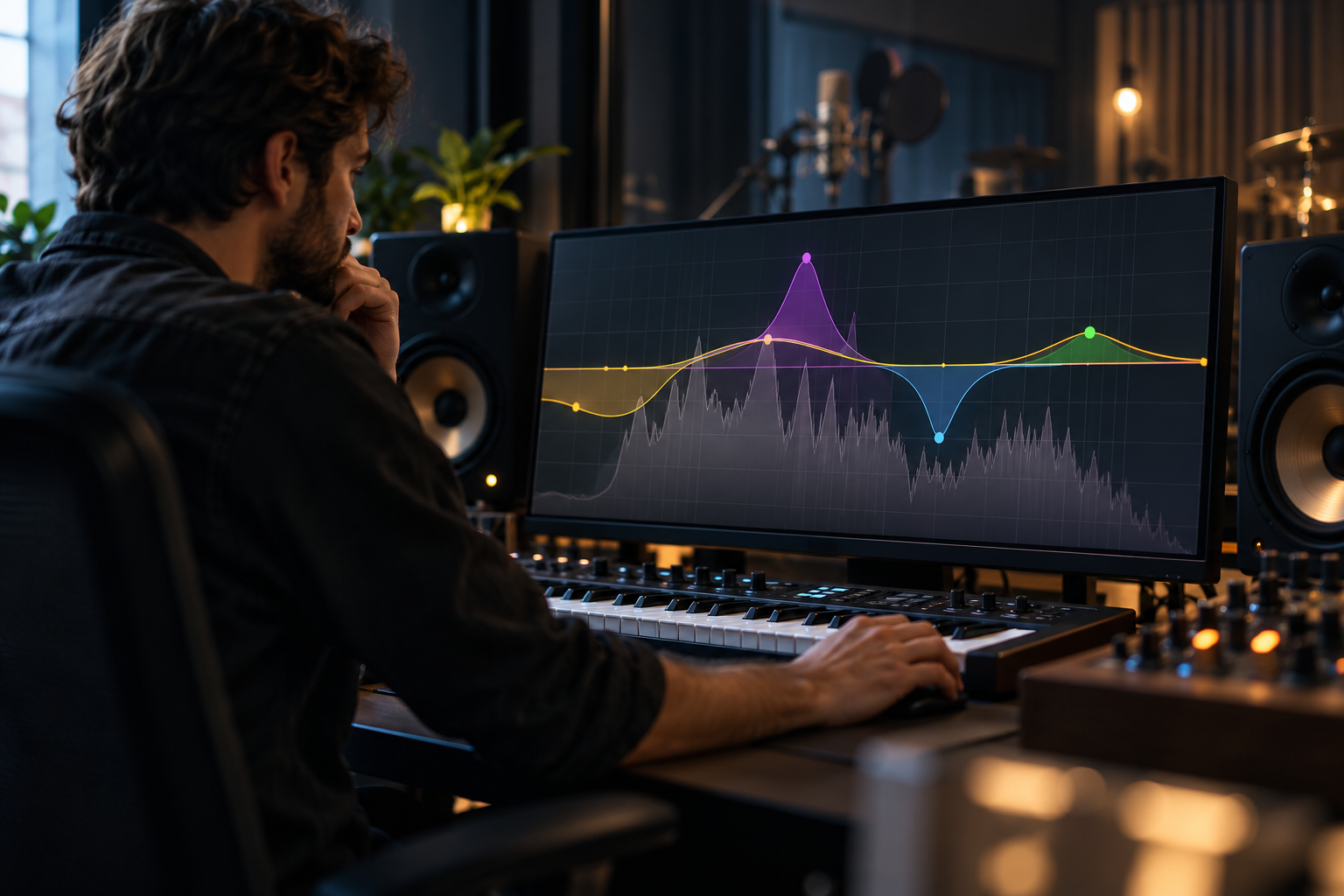
I have no verification that Pro-Q 4 exists. That is the honest starting point. Nothing in FabFilter‘s release history, no store listing, no changelog I can point to confirms the product, and I am not going to build a review on a rumor and dress it up as a first look. What I can do is more useful for anyone mixing in a small room: take the rumors at face value for a moment, separate what a “dynamic EQ” upgrade would plausibly change about corrective work, and then ground every practical claim in tools that actually ship.
Because here is the thing. A dynamic EQ is not magic, and the free TDR Nova already proves it. A four-band dynamic EQ where each band reacts to the incoming signal and only applies gain when a frequency crosses a threshold is genuinely competitive with paid units costing far more, as the folks at Born To Produce put it. If Pro-Q 4’s headline move is dynamic behavior, the real question is not whether it sounds good. It is whether it changes how you treat a room problem, a resonance, or a boomy low end in a way a static EQ cannot.
So let me answer that honestly, per band.
What a dynamic EQ actually does that a static one cannot
Static EQ is a fixed decision. You find a resonance, you cut it, you move on. The problem: that resonance is not always there. A vocalist leans into a note and 900 Hz flares up. On the next line it is gone. A static cut applied to the whole take removes weight from every phrase to fix two of them.
Dynamic EQ makes the cut conditional. The band sits inert until the signal crosses a threshold, then it engages. That is the entire premise, and it is why dynamic EQ is the tool for taming resonances without killing character. For corrective room work in a small studio, it matters even more. The resonant node at your mix position is excited by certain sources and not others. A dynamic notch lets you catch the excitation, not amputate the frequency band outright.
Where it helps and where it lies to you
On a 100 to 200 Hz room mode, a dynamic band can buy you a couple of dB of control on the worst passages without gutting the low end. That is real. I have used Nova exactly this way on a mix bus when a static dip made the bass feel hollow. The dynamic band only bit when the low end pushed.
But dynamic EQ cannot fix the room itself. It masks the symptom on the material that triggers it. Change the arrangement, change the monitoring level, and the mode behaves differently. If you have read my earlier piece on bass traps versus EQ below 200 Hz, this is the same lesson in a new costume.
What “dynamic” can and cannot solve in a small room
Here is where I push back on the hype around any dynamic EQ, leaked or otherwise.
Dynamic EQ is a corrective tool aimed at the material, not the space. If your 63 Hz dip moves when you shift your head a foot, the monitor and the room are the problem, and no plugin restores what the geometry removed. That point belongs to my own measurement work, and it is the reason I treat dynamic EQ as a finishing move after the room is addressed, not a substitute for it.
There is also a stacking problem. Go too aggressive with dynamic cuts and you are effectively compressing narrow bands of the spectrum, which can introduce unnatural pumping if pushed hard. A light touch is the rule, the same discipline that governs multiband compression.
Setting it up like someone who measures first
Plugins reward measurement, corrective EQ especially. My workflow on any dynamic EQ band runs roughly like this:
- Set the threshold above the quiet passages. A dynamic band that engages on every note is just a slow compressor with a frequency address. Make it bite only on the problem.
- Start with narrow Q, widen later. A high Q isolates the resonance. Broad moves belong to a separate, gentler EQ stage.
- Watch for the gain-match trap. Louder reads as better. A/B with output compensation or you will chase louder instead of cleaner.
- Do not use it to flatten your whole frequency response. Corrective EQ fixes problems. It does not balance the mix.
One signal-chain point worth stating plainly. In a mastering chain, FabFilter Pro-Q 3 functions as the dedicated subtractive first stage, well before saturation, loudness, and limiting. That ordering logic holds for any dynamic EQ too: corrective cuts first, musical moves and dynamics processing after.
The free option you can actually try today
If the appeal is dynamic behavior and you are not ready to spend, download TDR Nova. It is Windows and Mac, VST3 and AU, and it does the four-band reactive thing. Use it on a problematic resonance this week. Learn how the threshold interacts with the band gain. If dynamic EQ earns a place in your workflow after that, the upgrade argument becomes concrete instead of a rumor.
The lesson holds whether or not a Pro-Q 4 ever ships. Dynamic EQ is one of the useful corrective moves available to a small-room engineer. It is not a substitute for measuring the room.