Bass Traps That Actually Work: Cheap Mineral Wool Builds Tested in a Small Room
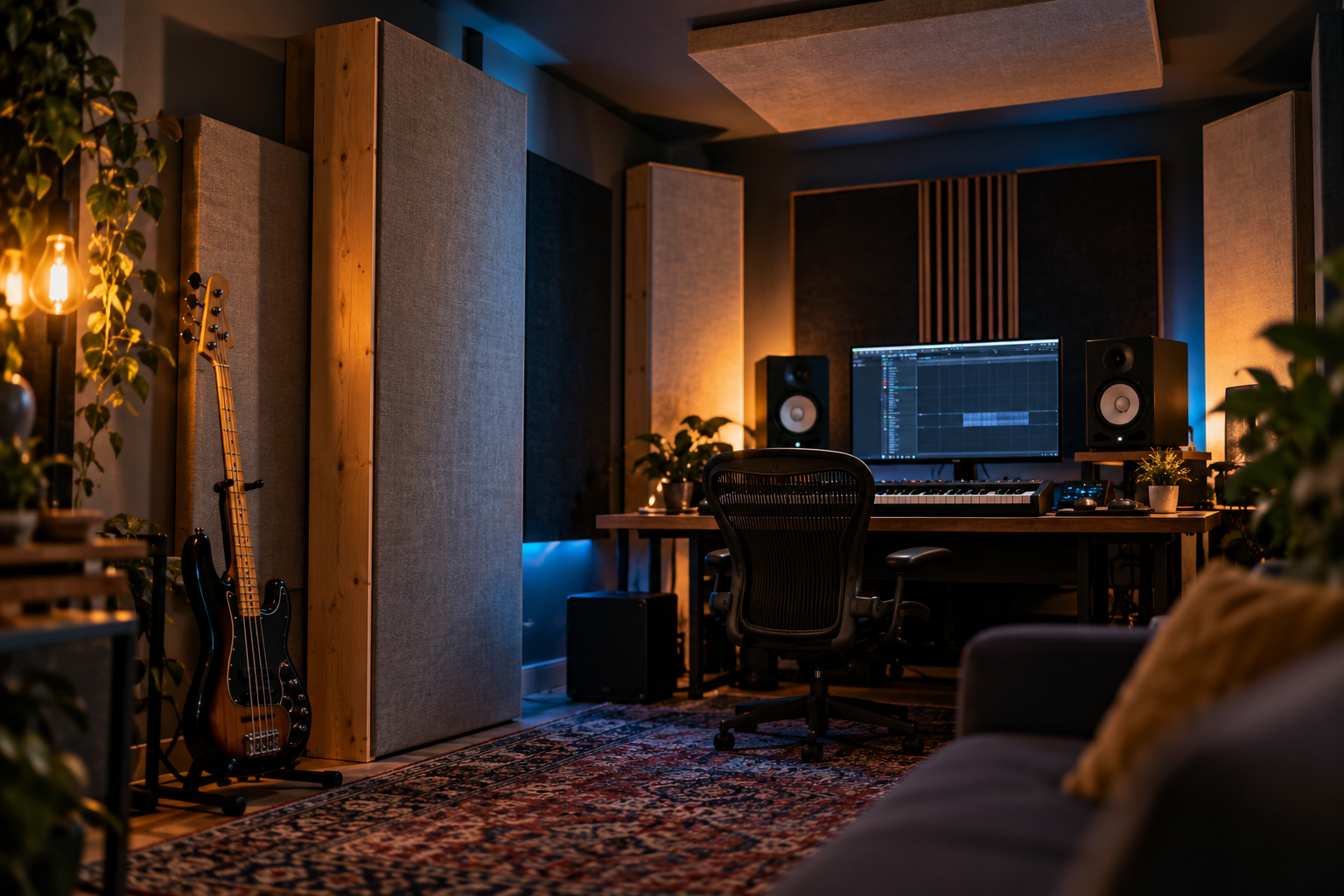
Two sheets of 100 mm Rockwool RW3, six timber battens, a box of screws, and a Saturday. That is the whole recipe for a broadband bass trap that will do more below 200 Hz than most of the commercial foam panels sold as “acoustic treatment.” I have built and measured enough of these now to have opinions about which cheap builds actually move the decay times, and which ones just look like you did something.
The context here matters. This is a small project room, not a purpose-built studio, and the goal is honest low-frequency absorption at a price that does not make you wince. Below is what I tested, what the measurements showed, and where the cheap builds fall short.
Why mineral wool, and why density is not the whole story
Mineral wool works because it is a porous absorber. Sound energy pushes through the fibers, friction converts it to heat, and the low end stops bouncing back at you. The physics are boring and reliable. What trips people up is the assumption that denser equals better.
It does not, not across the board. A very dense board reflects more at the surface before the wave ever gets inside, which hurts absorption in the upper bass even as it helps lower down. The practical sweet spot for a 100 mm panel straddling the 80 to 250 Hz range is a mid-density product, and Rockwool RW3 sits comfortably there. The fluffy loft insulation is cheaper still, but you need serious depth (200 mm plus) to get useful absorption where it counts. For a wall-mounted trap in a small room, RW3 at 100 mm is the more sensible starting point.
Keep the wool exposed or cover it in breathable fabric. A sealed plastic wrap or a painted face turns your absorber into a reflector. That single mistake undoes the entire build.
The three builds I actually measured
1. The simple wall panel (100 mm, air gap)
Two 600 by 1200 mm sheets of RW3, framed in 45 mm battens, mounted with a 45 mm air gap behind. The gap is not decoration. Spacing the absorber off the wall extends its effective working range downward, because the particle velocity of a low-frequency wave peaks some distance from the boundary. A panel flush to the wall wastes its potential; the same panel held off the wall catches more of the bass.
In my room this build took the sharpest edges off the 100 to 200 Hz region. It did not flatten the room. It reduced the ring. That distinction is the one worth caring about.
2. The corner stack
Corners are where low-frequency pressure piles up, so they are the obvious place to put mass. I stacked two 100 mm panels floor to ceiling across a vertical corner, leaving them unframed and fabric-wrapped. This is the build that earned its keep. Corner placement gets you more absorption per square meter of material than a flat wall panel, and a floor-to-ceiling stack catches the whole vertical standing-wave mode rather than a slice of it.
The catch is real: corner stacks eat floor space and look like exactly what they are. In a small room every corner matters for desk and door placement. Budget for that before you buy the wool.
3. The superchunk (triangular corner fill)
Cut the RW3 into triangles and stack them to fill the corner with a solid wedge. This is the most material-hungry build and the one with the best low-end reach, because the thickest part of the wedge gives you genuine depth where the pressure is highest. If your biggest problem sits below 100 Hz, this is the build to prioritize. If your problem is the 100 to 200 Hz region, the simpler air-gap panel does most of the same work for half the material.
What the traps did not fix
This is where I have to be blunt, because the internet is full of claims that bass traps solve everything. They do not.
A trap absorbs. It lowers the decay time of a mode, meaning the boom tails off faster and the room sounds tighter. It does not delete the mode. If a frequency is being reinforced by the room geometry, a trap reduces how long it rings but the standing wave still exists, and a single listening position can still sit in a null no absorber will fill. That is a placement problem, not an absorption problem, and it is exactly the sort of thing that shows up in a single-seat sweep versus a spatial average.
Nor do traps replace corrective EQ. They do different jobs. The trap shortens the decay the EQ cannot touch; the EQ trims the response the trap cannot reach. Reach for both, in that order. A parametric cut at a problem mode without any absorption underneath it is just a quieter ring, and you will hear the difference in how mixes translate.
Placement habits that pay off
A few things I do every time now, born from getting them wrong first:
- Measure before and after. One mic position, one sweep, same spot. Without a before-and-after you are guessing that the traps helped. The decay-time and waterfall views tell you what actually moved.
- Stack corners before you wallpaper the walls. Low-frequency absorption is the hard part. Spend your wool on corners first, then fill flat walls if any budget remains.
- Leave the gap. Mounting off the wall is free absorption. Do not press panels flat against the surface.
- Do not over-damp the top. Going too heavy on absorbers everywhere turns a small room dull and lifeless. Broadband traps in the corners plus a couple of first-reflection panels are usually plenty.
Real costs, real verdict
This is a budget build. A pack of mineral wool, timber, screws, and breathable fabric comes in well under what a single branded commercial trap costs, and you get several panels out of it. The trade is your time and a workshop morning. If you have a saw and a drill, the math favors building.
If you do not, or if your room has awkward corners you cannot commit to filling, commercial corner units are the pragmatic buy, and I would not talk you out of them. But for a small room with a defined low-end problem and a tight budget, the mineral wool corner stack is the build I keep coming back to. It is cheap, it measures, and it does not pretend to be more than it is.
The honest summary: mineral wool traps reduce the decay that makes small rooms sound small. They will not rescue a bad monitoring position or replace a proper response correction. Build the corners first, measure what changed, and let the data decide whether you need another stack.