Best Budget Studio Monitors Under $500 for a Small Treated Room
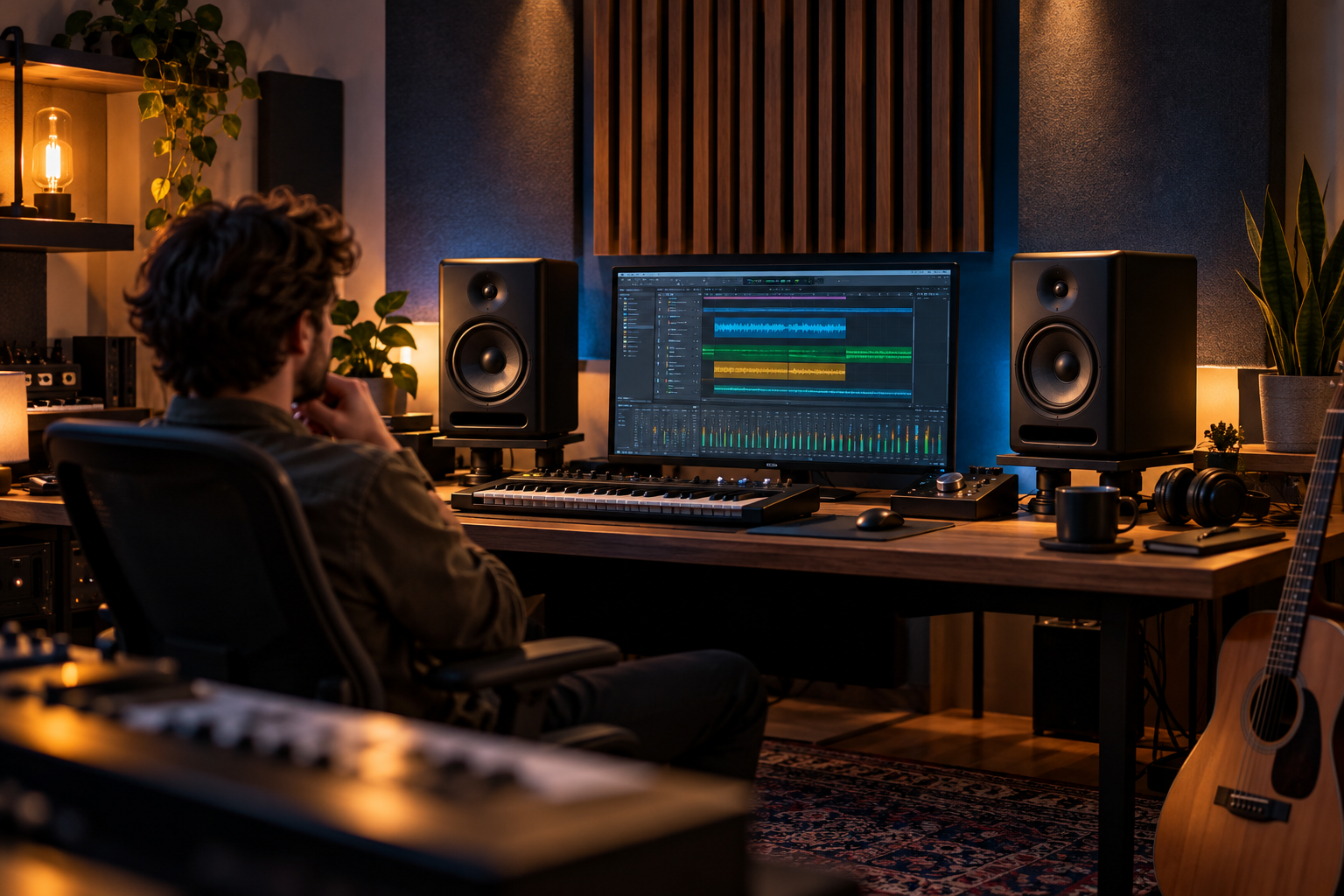
Five hundred dollars does not buy you a pair of monitors that tell the truth. It buys you a pair that lie consistently, and consistently is the part you can work with. I have mixed on cheap nearfields in a small treated room for years, and the lesson never changes: the speaker matters less than whether you know how it lies and whether the room lets you hear that lie without smearing it.
So this is not a list of the flattest speakers under $500. It is a list of what I would actually put on stands in a small room that already has bass traps and first-reflection panels, plus the reasoning behind each pick and the places where the budget forces a compromise you need to hear before you buy.
Start with the room, not the speaker
A small treated room changes the calculus. If you have already handled the corners and the early reflections, you have removed the two things that make cheap monitors sound worse than they are. What is left is the speaker’s own voicing, and now you can actually hear it.
This is why I would spend the money on treatment first and monitors second. A $400 pair in a treated 3x4m room will out-mix a $1,500 pair in an untreated one. The room is the largest filter in the chain, and every measurement I have taken in small rooms confirms it.
With that said, here is where the budget goes.
The picks
Yamaha HS5: the reference point
Around $200 per speaker, the HS5 is the default answer for a reason. It is bright in the upper mids, it has almost no low-end below about 70 Hz, and it makes bad mixes sound bad. That last part is the feature. The HS series has been the nearfield people learn to mix on for over a decade, and the HS5 is the version that fits a small room without fighting it.
The honest downside is the bass. There isn’t any to speak of. If your genre lives below 80 Hz, you will be guessing, and guessing is not mixing. Pair it with a subwoofer you trust, or accept that you are mixing midrange and checking the low end on headphones.
Note that prices move. I have seen the HS7 quoted around $320 per speaker in buying guides, and the HS5 sits well under that. Check current pricing before you commit.
Kali Audio LP-6 v2: the value pick
If I had to recommend one speaker to someone with $400 and a treated small room, it would be the Kali LP-6 v2. The waveguide gives you a wide sweet spot, which matters in a room where you cannot sit perfectly centered every session. The front-ported cabinet means you can push it closer to the front wall without the port chuffing, and in a small room that is not a small thing.
It also has boundary compensation switches on the back. These are not a substitute for treatment, but they let you trim the low end when the speaker is forced into a corner. Use them, then measure, then adjust again. The switches are a blunt tool, not a fix.
The LP-6 is not flat. Nothing at this price is. But it is honest enough that the corrections you make in your DAW translate.
JBL 305P MkII: the imaging pick
The 305P MkII has the image. The waveguide produces a surprisingly stable center and a sense of depth that the HS5 cannot match. For a small room where you are mixing at low volume, that image is worth more than flat frequency response, because it is what lets you place elements in the stereo field with confidence.
The trade-off is the low end again, and the cabinet is small enough that it will not pressurize a room. It also hisses slightly at idle. In a quiet room you will hear it. Some people cannot live with that. I can, but you should know before you buy.
What $500 does not buy
It does not buy you a speaker that goes flat to 40 Hz in a small room. Physics does not care about your budget. Every monitor in this range rolls off somewhere in the 50 to 70 Hz region, and the room will impose its own modes on top of that.
This is the part where people get disappointed. They buy the speaker, put it on a desk, and wonder why the bass is a mess. The answer is almost never the speaker. It is the desk, the wall behind it, and the corner the speaker is sitting in.
You need stands. You need the tweeter at ear height. You need the speakers pulled off the front wall by at least a foot if the cabinet allows it. You need a measuring mic and a free afternoon. The $500 is for the speakers. The rest is time and attention, and it is not optional.
The subwoofer question
If your budget is strictly $500 for the pair, a subwoofer is out of reach. If you can stretch, a modest sub crossed at 80 Hz will do more for your mixing than upgrading from an HS5 to an HS7. The low end is where small rooms lie most, and a sub you can place and measure gives you control that the main speakers cannot.
But a badly integrated sub is worse than no sub. If you cannot measure and place it properly, skip it and learn your speakers’ roll-off instead. Know where they stop telling the truth, and check that region on headphones you trust.
How I would actually choose
If you mix rock, pop, or anything midrange-forward, the HS5 is the safe, boring, correct choice. You will learn it in a month and it will never flatter you.
If you want the widest usable sweet spot in a small room and you value a forgiving listen, the Kali LP-6 v2 is the pick. It is the one I would buy with my own money today.
If stereo placement is the thing you struggle with, the JBL 305P MkII gives you the clearest picture of where things sit. Accept the hiss and the missing bottom octave.
None of these are the last monitors you will buy. They are the ones that will teach you what your room sounds like, and that lesson is worth more than the speakers themselves. Buy the pair that fits your room, treat the room first, and measure before you trust anything you hear.