Nearfield Monitors Under $800: Five Pairs Compared on Real Material
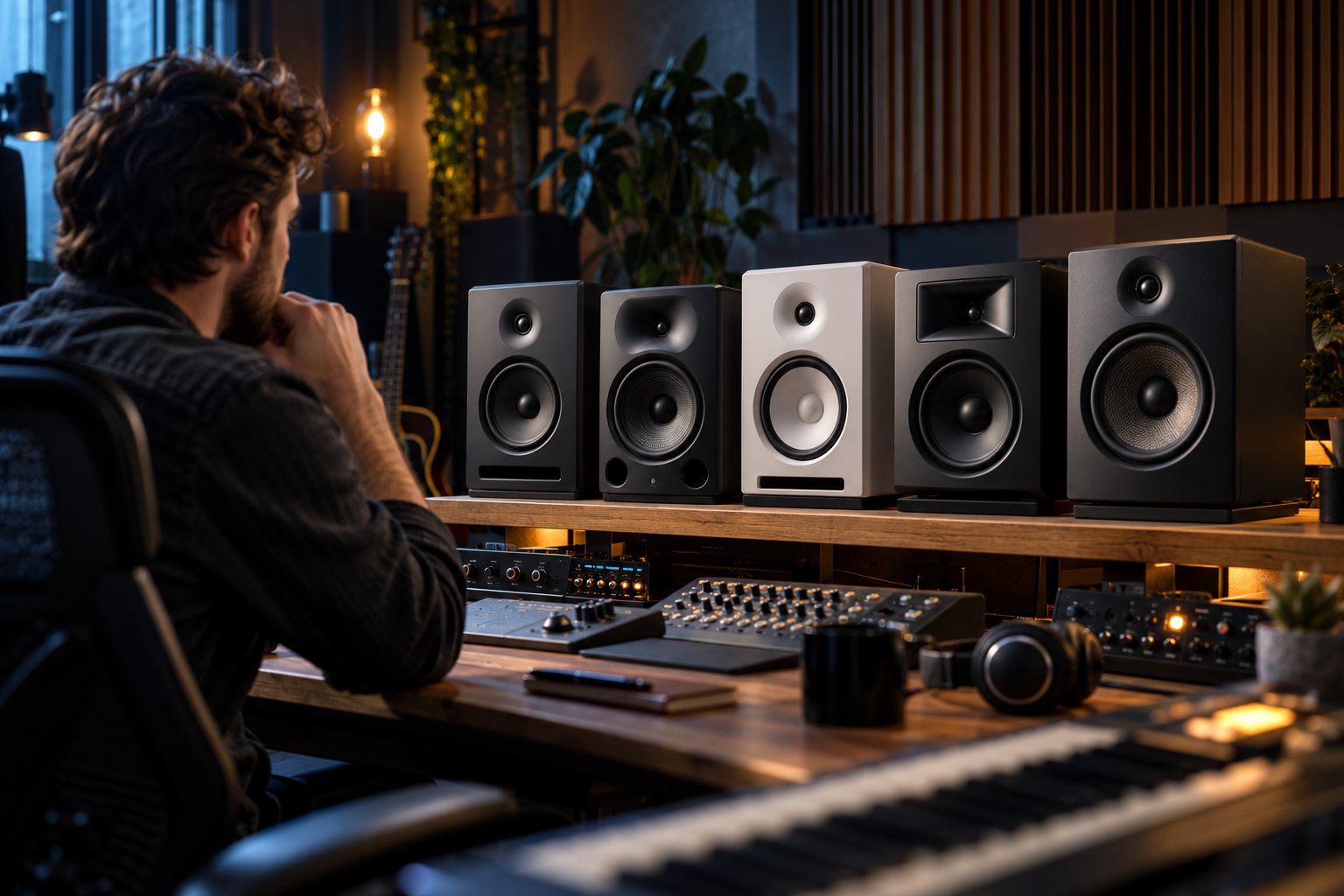
Five pairs of nearfields, one treated-ish room, and the same six reference tracks on repeat for a week. That is the only way I know to compare monitors in the $600 to $800 window without getting fooled by a showroom or a spec sheet. This is not a shootout where I crown a winner. Each of these pairs does something well and something that will annoy you in a small room.
My setup for the whole test: a 3.5m x 4.1m room with 2.4m ceilings, bass traps in the front corners, first-reflection panels at the mirror points, and the desk pulled back from the front wall. Not perfect. Real. If your room is worse than this, your results will differ, often a lot. Nearfields are room-limited tools, and a $700 pair in an untreated corner will lose to a $400 pair placed well.
I listened at roughly 75 dB SPL C-weighted at the mix position, then re-checked at lower volume. I A/B’d pairs back to back, one afternoon each, then rotated back through all five at the end to catch anything I had talked myself into.
How I judged them
Four things matter to me more than frequency response brochures: how the low mids translate, whether the tweeter tells me anything about 3 to 6 kHz without lying, how the pair images, and how bad it sounds when I turn it down to 65 dB. Small rooms at low volume are where most mixes actually get made.
Yamaha HS7
The reference point. The HS7 is the monitor everyone has heard, and that is a real advantage: if you know how it sounds, you know what “translating” feels like on it. The midrange is honest without being clinical, and the pair images solidly across the desk. The classic criticism holds, though, and it is the one I keep running into: the top end is forward. On bright material it will tell you more than you wanted to know about your cymbals and your consonants.
In a 3.5m room they also reach lower than their cabinet size suggests, which is both good and bad. Good because you can hear kick and bass fundamentals. Bad because the low end is the least reliable part of the picture in a room this size, and the HS7 will not tell you when it is the room talking rather than the speaker.
Verdict: still the pair I would recommend first to someone who wants to learn what a mix sounds like before they buy a fancy monitor. The forward treble is a genuine annoyance, not a dealbreaker.
Adam Audio T7V
The T7V is the one I expected to love, and I half did. The AMT tweeter gives you detail that the HS7 partly smears, particularly around 4 to 8 kHz, and the imaging feels a touch wider and more open. On acoustic material and heavily layered synth pads, it tells you what is going on in the upper mids with less fatigue.
Where it loses points for me is the low end, which felt a little soft and a little late compared with the Yamaha. Not wrong, just less definite. If your room already has an issue under 100 Hz, you may not notice. If it is reasonably controlled, you will.
Verdict: the better monitor for detail work and the more pleasant listen across a long day. Slightly less sure of itself down low. For a lot of people that trade is worth it.
Kali Audio LP-6 v2
The LP-6 v2 is the one that surprised me most. The front-ported cabinet behaves better on a desk close to a wall than I expected, and the boundary and placement controls on the back actually do something audible when you use them. This matters enormously in a small room, and most monitors this cheap do not offer it.
Tonally it is a little darker than the Adam and a little more relaxed than the Yamaha. The midrange is not as articulate as the HS7, which showed up on dense rock mixes where I wanted to hear the guitar body. But the stereo picture is stable and the bass is honest, which is more than I can say for some pairs at this price.
Verdict: the most small-room-friendly speaker of the five, and the one I would pick if my desk sat close to a wall and I could not move it. The midrange articulation is the cost.
Focal Alpha 50 Evo
The Focal is the most expensive-feeling pair here in the hand, and the midrange is the reason to consider it. Voices and guitars sit in a clear pocket, and the transition from the woofer to the tweeter is smoother than most. I found myself hearing small balance problems I had missed on the others.
The catch is the low end. The 5-inch woofer is honest but does not go deep, and it does not pretend to. If you are mixing anything with synth bass or a busy low end, you will want to know what is under 60 Hz, and this pair will not tell you. Pair it with a sub or accept that you are trusting your metering for the bottom octave.
Verdict: the best midrange clarity of the group, and the worst low-frequency extension. A specialist’s tool, not an all-rounder.
Genelec 8010A
The 8010A is the outlier: a tiny, sealed, aluminium-cabinet monitor that costs more per inch than anything else here. It sounds like a much bigger speaker in the mids and highs, and the imaging is the tightest of the five. The build feels like a piece of lab equipment.
It is also ruthlessly honest about how small it is. There is almost no output below roughly 70 Hz, and the low mids are lean. If you want to hear what your bass is doing, this is not the pair for that job. If you want to hear what your mix is doing above 100 Hz in a small room, this is the cleanest window of the group.
Verdict: a brilliant second reference, a frustrating only reference. I would buy it alongside a bigger pair, not instead of one.
What actually mattered
Three things separated these more than any spec.
- Placement controls. The Kali’s boundary settings earned their place. A monitor that lets you correct for a rear wall is worth more than a monitor with a flatter anechoic curve.
- Low-end honesty versus extension. The Focal and Genelec go less deep but lie less. The Yamaha and Kali go deeper and take more judgement from you. None of them solve the room.
- Fatigue. Across a full day, the forward treble of the HS7 and the brightness of the Adam wore me down. The Focal and Genelec did not. If you mix for eight hours, this matters as much as frequency response.
If I had to pick one pair for a small, imperfect room and a limited budget, it would be the Kali LP-6 v2, mostly because of the placement controls. If I had a bit more and cared most about detail, the Adam T7V. If I mixed vocals all day, the Focal Alpha 50 Evo. The HS7 remains the safe, known quantity. The Genelec 8010A is the one I would add later, not start with.
One last thing. Before you spend anything, measure your room. A single-seat sweep with a measurement mic will tell you more about which monitor will work in your space than a week of reviews. I have written before about why a spatial average hides problems a single-seat sweep reveals, and why a dip at 63 Hz can move when you lean forward. Monitors are the variable you change last, after you understand what the room is doing.