Sofa, Rug and Bookshelf: Testing Whether Furniture Actually Fixes a First Reflection
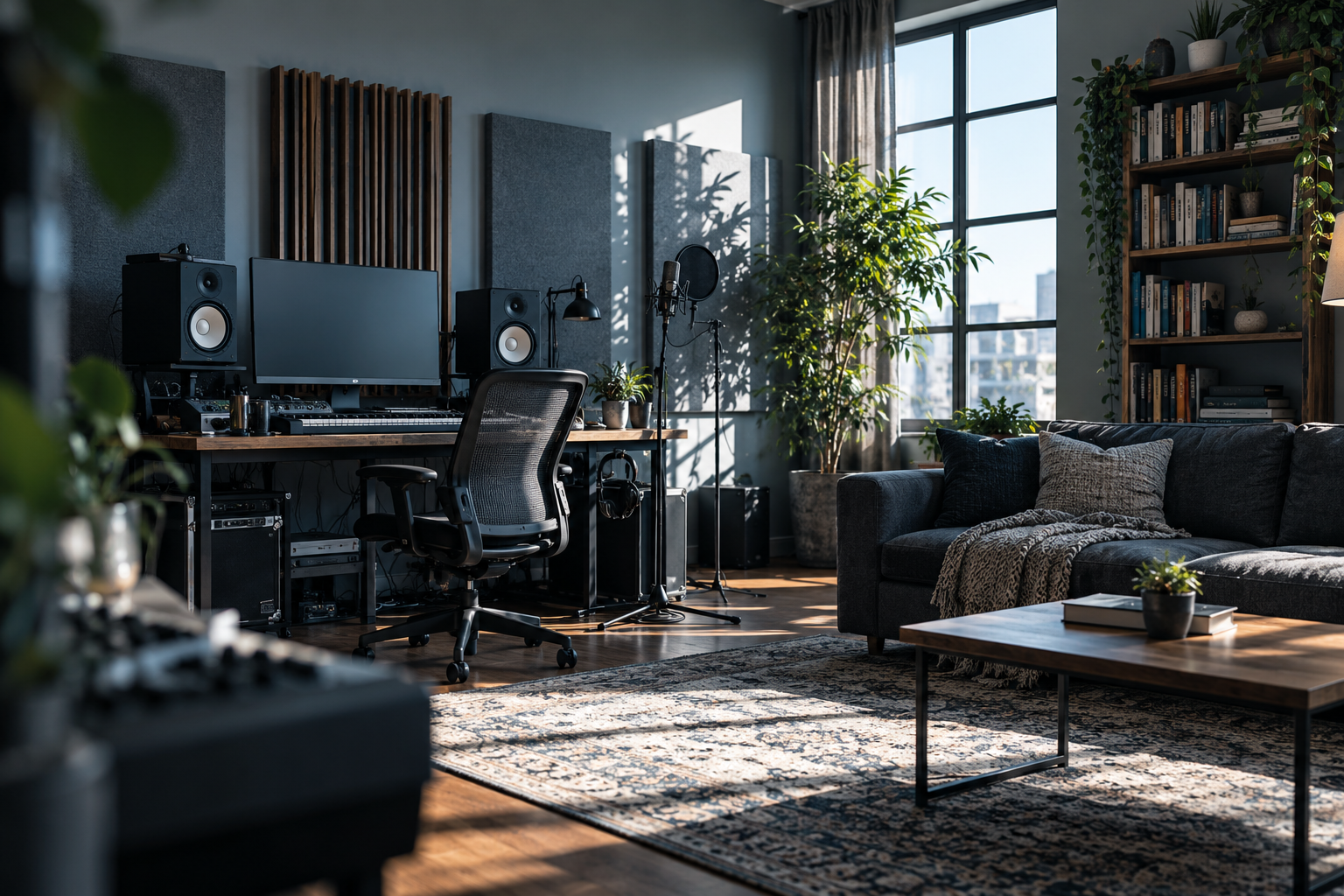
The first reflection off the wall beside your left speaker is not a small problem, and soft furnishings do not remove it. I say that as someone who has spent more evenings than I care to admit shuffling a sofa six inches at a time to see if the measurement would budge. It does budge. Just not in the direction most people expect.
So here is the test I keep running, and the result I keep getting: a sofa, a thick rug and a loaded bookshelf will change how a room sounds. They will not reliably fix a first reflection. Those are two separate jobs, and mixing them up costs you money and time.
What a first reflection actually is
Sound leaves the tweeter, hits a hard surface near the speaker, and arrives at your ear a few milliseconds after the direct signal. The precedence effect, the way your brain locks onto the first wavefront and suppresses later ones, means you often do not hear it as a distinct echo. A single reflection arriving between roughly 5 and 30 ms after the direct sound can be up to 10 dB louder than the direct sound without registering as a separate event. Your ear hides it. Your ear does not fix it.
That late arrival smears the impulse response, and the frequency response at the listening position shows comb filtering: a series of peaks and dips spaced by the path-length difference. It is the dip pattern that makes a vocal sound hollow, not the echo you never consciously heard. The fix is absorption or diffusion at the reflection point, or moving the speaker or listener so the reflection geometry changes. Fabric draped over a hard wall at the reflection point does some of this. A sofa across the room does almost none of it, because it is not where the reflection is.
The three things, tested
I measured each change at the same mic position with Room EQ Wizard, which gives you SPL, impulse, RT60 and waterfall views for free and is the tool I keep coming back to. Everything below is a single listening room, one pair of standmounts, one mic, one sweep repeated until it looked stable.
The rug
A thick rug on a bare floor changes the floor reflection. That is real, and it is worth doing. But the floor reflection is mostly in front of and between you and the speakers, and a rug of normal size rarely covers the whole first-reflection zone on a hard floor. You will see the high-frequency decay shorten a little in the waterfall. You will not see the side-wall comb filter that is actually annoying you change at all. The rug is a good idea that solves a different problem than the one you think it solves.
The sofa
Moving the sofa to the side wall behind the listening position does the most of the three, but not because it absorbs anything useful. It changes the geometry. Pushing the seat and the listener forward or back by a foot shifts where every reflection lands relative to your head, and that shift can move a null. I measured a comb-filter null that moved several hundred hertz after I slid the sofa back against the wall. That is a furniture change doing measurement work. It is also a change you could have got by moving the mic half a metre, which tells you what kind of fix it is.
The bookshelf
A loaded bookshelf is a diffuse scatterer, and on the rear or side wall it genuinely breaks up a specular reflection. Irregular surfaces spread energy in many directions instead of one, and that is closer to what a reflection point wants than a flat absorber is in a small room. If the shelf is full of books of different depths, the scattering is uneven and broadband. That helps. What it does not do is absorb the reflection, and it cannot help if it is not in the first-reflection triangle between the speaker and your ear.
The part nobody measures
Reverberation time. Every object in the room affects it, including people and their belongings, and RT60 is shaped by surface area and material as much as by the hard surfaces you can see. A rug, a sofa and a bookshelf all add soft, irregular surface area and shorten the tail slightly. On a bare-room-to-furnished-room comparison the RT60 will drop, and the room will sound less shouty. That is a real improvement.
But shortening the overall decay does not address a discrete early reflection that arrives at one bad moment. The two are different acoustic events on different timescales. Furniture fixes the diffuse field, the thing that makes the room sound alive or dead. Treatment fixes the early, discrete first reflections, the things that comb-filter your direct sound. Confuse the two and you will keep buying cushions.
The measurement that tells you which you have
In REW, look at the impulse response and the energy-over-time view, not just the frequency sweep. A first reflection shows up as a distinct spike a few milliseconds after the main impulse. Furniture changes the broad decay tail. If you see a sharp secondary spike after the direct, that is a specular reflection and no amount of upholstery in the middle of the room will move it. If you see a long, slow tail, the room is too live and soft furnishings are the right weapon.
You can also gate the window on the impulse, which lets you isolate the direct sound from the reflections. The difference between the gated and ungated frequency response is roughly the cost of your reflection problem. Look at it before you look at a sofa catalogue.
Where furniture is the right answer
For a room that is simply too reverberant, the furnished room wins and it wins cheaply. You do not need broadband absorbers on every wall to fix a flutter echo in a bedroom studio; you need soft, broken surfaces and a few people in the room. Treatment panels at the reflection points come next. Furniture is the base layer that makes everything else less hyped.
For a room with one dominant early reflection off a hard side wall, the answer is a panel at that point, or a repositioned speaker, or an angled surface. The bookshelf only helps if it is already sitting where the reflection happens to land. If it is not, move it or accept the comb filter and fix it in the mix if you are producing, or in the room if you are monitoring.
What I would actually do
Treat the rug and sofa as baseline room conditioning, not as reflection control. Measure the room first. Look for the early spike in the impulse response and for the comb pattern in the sweep, and only then decide whether the fix is a panel, a speaker move, or a piece of furniture.
The test that settles it: run one sweep with everything in place, then run it again with the sofa pulled away from the wall behind the listening position. If the nulls move, the geometry changed and you can solve it by positioning. If they stay put, the reflection is coming from somewhere your furniture is not, and you need something on that surface. Stop buying cushions; start reading impulse responses.