Setting a subwoofer crossover by measurement instead of by the manual
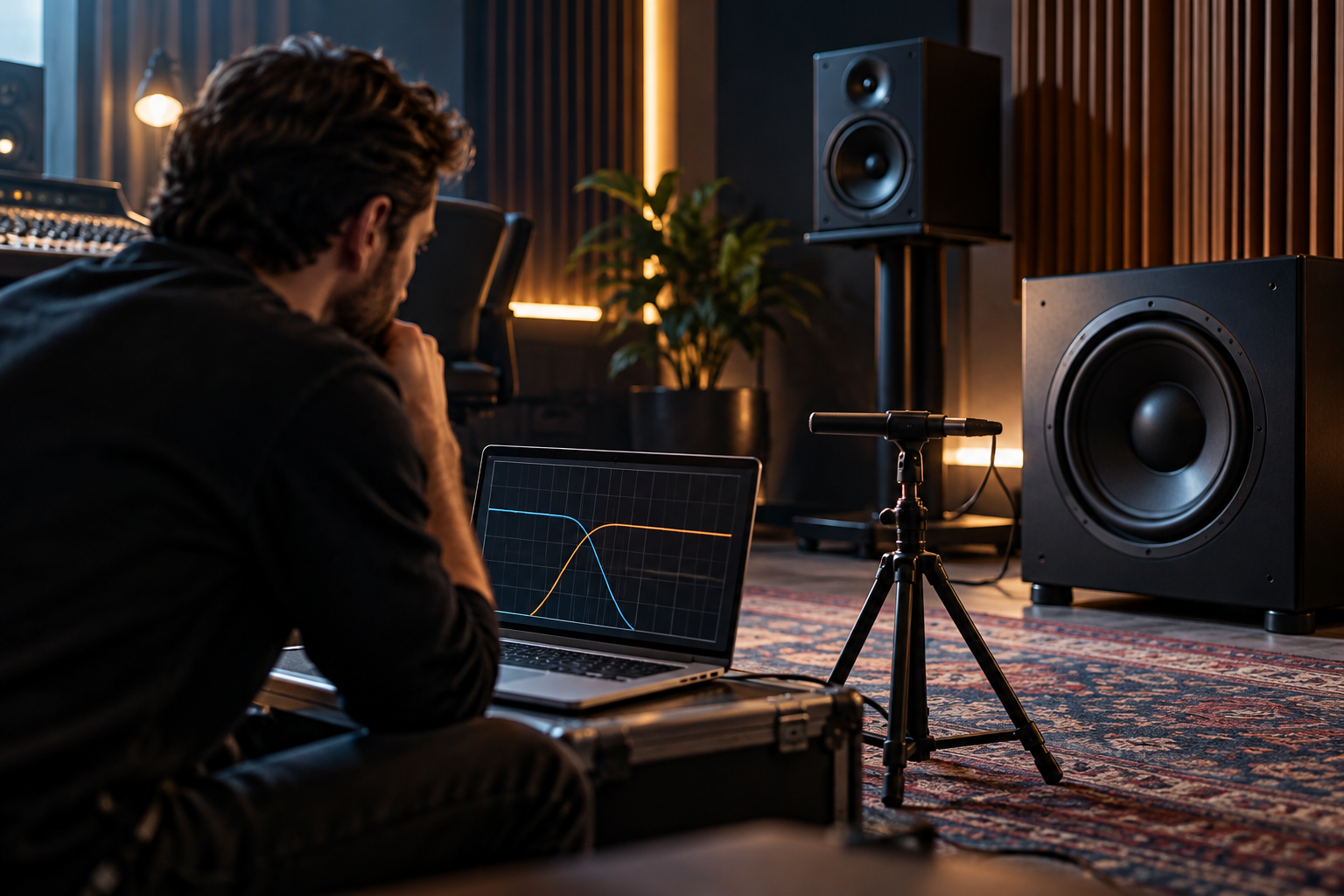
The manual said 80 Hz. The room said 52. I ran the sweep, looked at the summed response, and moved the dial. That is the whole article in one sentence, but the reasoning behind it is where people get stuck.
Subwoofer crossover is not a preference. It is a filter alignment you are trying to hit in an actual room, and the number on the plate is a starting point for a system whose acoustics you have not measured yet. Let me lay out how I do it on a calibration visit, and where the textbook alignment stops being useful.
What the crossover actually is
In a bass-managed system, the receiver splits the signal. The main channels get a high-pass filter, the sub gets a low-pass. The textbook version, per the bass management writeup, is a 12 dB/octave Butterworth high-pass on each main channel paired with a 24 dB/octave Linkwitz-Riley low-pass on the sub feed. The target is that both filtered signals land at −6 dB at the crossover frequency, which sums to a reasonably accurate 4th-order Linkwitz-Riley acoustic response.
Read that again. The target is at the crossover frequency, not at the driver.
That alignment is designed around the natural rolloff of the main speakers. Sealed boxes fall off around 12 dB/octave. Vented boxes run 18 to 24 dB/octave. The whole point of the filter pair is to hand the low end over smoothly without a bump or a hole. Typical range is 40 to 80 Hz. A 60 Hz crossover is a common illustration, but it can sit anywhere in that window depending on the speakers.
Why the manual number is usually wrong
The manual gives you a frequency chosen for a generic case. It does not know your room. It does not know where the sub sits relative to the mains. It does not know the boundary loading at the listening position.
Here is the practical failure mode. You set 80 Hz because the spec sheet says the mains reach 80. You measure, and there is a 6 dB dip centered right at the crossover. Or a hump. Either way, the handoff is not smooth, because the mains did not roll off at 80 in your room. They rolled off at 70. Or the sub’s own acoustic rolloff adds to the low-pass and drags the effective transition lower than the dial says.
The filter does not exist in a vacuum. Its output is the filter convolved with the speaker’s real response in the real room. So you cannot pick a crossover number from a paper spec. You have to measure the sum.
How I measure it
I use a measurement microphone at the listening position, run a sweep per channel, then a summed sweep. A few things matter:
- Measure with the crossover engaged. Individual sweeps of main and sub tell you about each driver. The summed sweep tells you about the handoff, which is what you are actually tuning.
- Use the same drive level for every pass. Level-dependent compression in the sub will skew the picture if you change volume between sweeps.
- Look at the octave around the crossover, not the whole 20 to 200 range. Zoom in. A 1/24-octave smoothing around the target frequency shows the dip or hump clearly. Full-range smoothing hides it.
- Compare polarity on the sub feed. A half-wavelength offset between sub and mains at the crossover frequency can produce a deep notch. Flipping polarity sometimes fixes it outright before you touch the frequency dial.
Then you iterate. Raise or lower the crossover, re-sum, look again. Small moves. 10 Hz steps, not 40.
The LFE trap
One thing the manual and the receiver menu often blur together: the LFE channel is not the subwoofer channel. The bass manager routes low frequencies from all channels to the sub, not just the .1 content. The LFE channel for movies extends to 120 Hz, and some receivers apply a fixed 120 Hz low-pass to it during playback. That filter is independent of your main-channel crossover setting.
This matters when you measure. If you sweep a multichannel source, the LFE content and the redirected bass from the mains are both going to the sub, and they can interact. Cheap receivers with only one fixed filter (often 80 Hz) give you no independent control anyway. On those, you set the sub level and live with the rest. Better receivers let you set the main crossover and the LFE low-pass separately. Use that.
Dolby’s 5.1 music mixing guidance, referenced in the same writeup, recommends rolling off the LFE at 80 Hz on limited receivers so content between 80 and 120 Hz does not get lost in the sum. Worth knowing when you are calibrating a mixed-use system for both music and film.
Where the textbook alignment stops helping
The 4th-order Linkwitz-Riley target assumes an anechoic speaker with a clean 12 dB/octave rolloff. Your room is not anechoic. Boundary reflections, modal peaks, and the sub’s own placement all bend the summed curve.
I have had rooms where a textbook 80 Hz crossover measured beautifully in the individual sweeps and produced a 7 dB dip in the sum, because the mains rolled off early and the sub’s acoustic rolloff compounded the electrical low-pass. I moved the crossover to 62 Hz, the dip flattened, and the system sounded more coherent. The number on the dial is not the target. The measured sum is the target.
I have also had the opposite. A vented pair that fell off steeply around 70 Hz, and raising the crossover to 90 Hz gave a smoother handoff than 80, even though 80 was “correct” on paper. The measurement does not care what the manual says.
What to actually do on the next visit
- Set the crossover to the manual recommendation as a starting point, nothing more.
- Sweep the summed response at the listening position, zoomed to the octave around the crossover.
- Check polarity on the sub feed before you move the frequency dial.
- Step the crossover up or down in 10 Hz increments, re-summing each time, until the handoff is smooth in the measurement.
- Confirm the LFE low-pass is set independently from the main crossover if the receiver allows it.
Two hours of measurement beats an afternoon of guessing from the manual. The system will tell you where it wants to cross. You just have to point a mic at it and listen to what it says.