Delay and level calibration for a seat that had to stay against the back wall
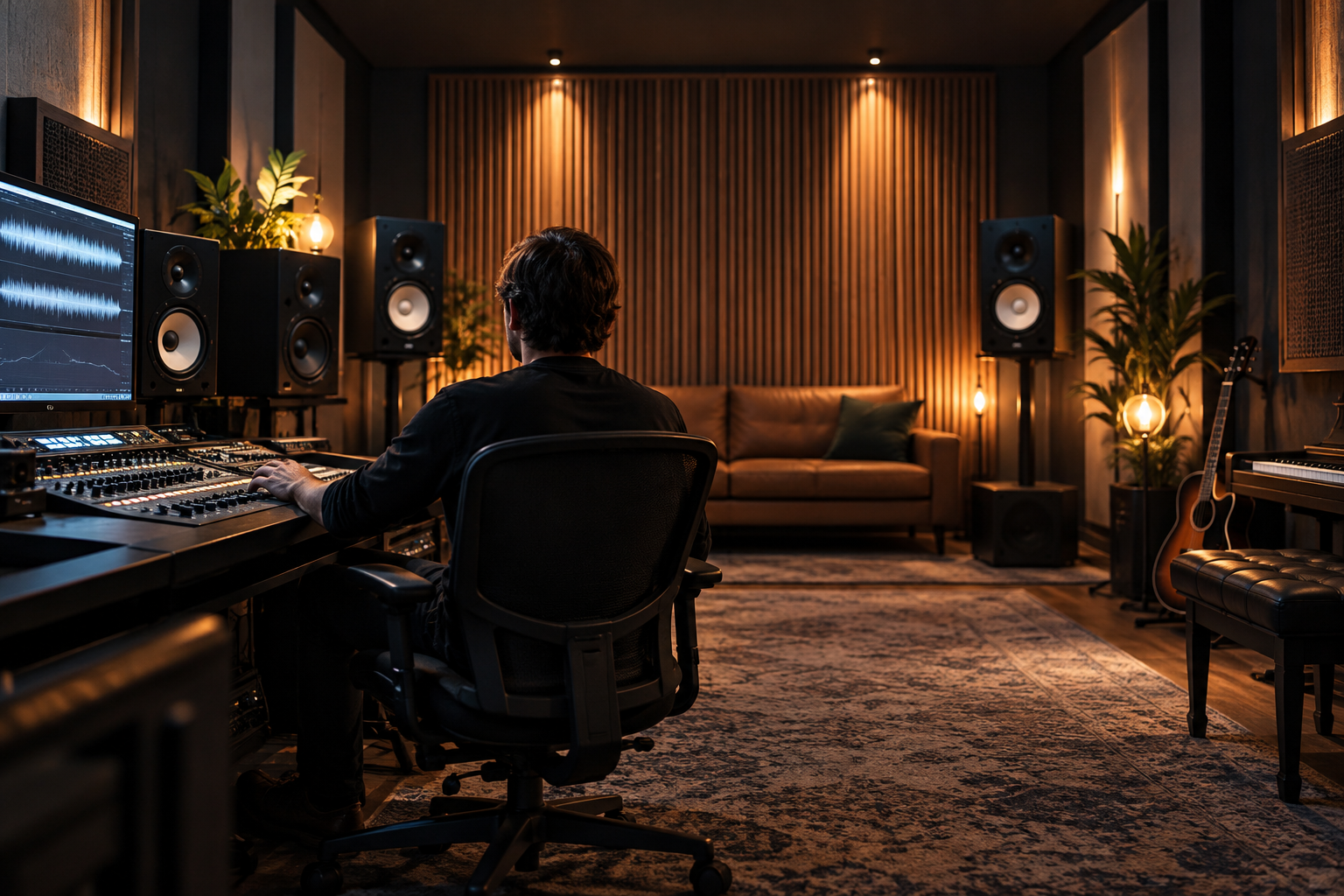
The room had one non-negotiable: the sofa had to sit against the back wall. No floating pull-out, no 60 cm crawl space behind it, no rear-ported towers with breathing room. My client had a small den, two doorways, and a spouse who had already agreed to the speakers. The wall was where the wall was.
So I stopped treating that seat as a compromise and started treating it as a spec. Two things had to be done properly before any EQ was considered: get the delays right, and get the levels right. Not because they are glamorous, but because every later correction depends on them being honest first. This is what I actually did, in order, with the numbers I could stand behind.
Why delay matters more than usual when you sit against a wall
When the listening seat is jammed near a boundary, the earliest reflection off that back wall comes back fast. Faster than you might think. The speed of sound in dry air at 25 °C is roughly 341 m/s, so a surface about a meter behind your head returns the reflection in a few milliseconds. That is well inside the window where the ear refuses to hear it as a separate event and just folds it into the direct sound.
That is the precedence effect doing its job. Haas showed the delayed arrival still gets fused with the first wavefront even when the delayed sound is up to 10 dB louder, but only for delays between roughly 10 and 30 ms. Outside that window, or outside the level relationship, the fusion breaks and you start hearing the boundary as a smear or a boom rather than a clean reflection. Sitting against a wall pushes some of that energy into either extreme, which is exactly why the seat felt muddy before I touched anything.
None of that is solvable with a delay setting on a processor. Delay in a room correction context is a different animal, and it is the one I had to get correct first.
The delay correction, done by the numbers
Here is the mechanical part, and it is mechanical. A correction system measures the impulse response at the seat, per channel. The impulse peak’s distance from the start of the signal is the channel’s delay, and its sign tells you the polarity. To align the channels, you subtract each channel’s delay from the system’s peak delay and apply that difference as added delay to the earlier-arriving channel. Some tools show you the result as a distance from the speaker instead, which is just the delay multiplied by the speed of sound.
For this room the process was:
- Swept-sine measurement at the single seat, one channel at a time. The chirp maximizes signal-to-noise and lets you deconvolve to a clean impulse response.
- Read the impulse peak position for left and right. The difference between them is the misalignment you are correcting, not an absolute you chase.
- Subtract each channel’s delay from the peak delay, apply the remainder as additional delay on the near channel.
- Watch the polarity warning. If the sign flips on one side, suspect swapped speaker leads before you trust the impulse.
One honest caveat on polarity. Some speakers are wired inverted on purpose. The Focal Kanta line does this deliberately, and if you “fix” it with a sample inversion or a wire swap you have made the speaker wrong. So when a polarity warning appears, I check the documented behavior of the specific model before I touch a cable, not after.
The delay numbers only tell me the channels agree. They do not fix what the back wall is doing to the low end. That part is a level and placement problem, and no delay value will hide it.
Levels: the part almost everyone skips
Delay gets the channels into time. Level gets them into balance. Together they are the foundation that any digital room correction filter sits on, and if either is wrong the correction is being asked to fix a geometry problem with an EQ curve.
Here the back wall does something predictable. Boundary reinforcement lifts the low end, and it lifts it unevenly across the two channels if the speakers are not equidistant from their respective side and rear surfaces. My seat was offset toward one side, so the left speaker was closer to a corner than the right. That asymmetry shows up as a level and bass imbalance that a single overall trim will not address.
What I did, in plain terms:
- Set both channels to the same reference level at the seat using a calibrated measurement, not a phone app.
- Checked band-limited balance across the bass region separately, because the corner-loaded side carried more low-end energy than the free side.
- Confirmed the trim matched what the measurement said, then stopped. Over-trimming to “feel” balanced reintroduces the imbalance at a different frequency.
This is the point where I will contradict a lot of advice you will read. If the level mismatch in the bass is large, do not reach for EQ to flatten it. Move the speaker a few centimeters, or accept the asymmetry and document it. A level trim with a real measurement behind it is honest. A parametric filter guessing at a boundary problem is not.
Where the room correction filter belongs, and its cost
Only after delays and levels were right did I load a correction filter. The way the systems work is consistent: measure the impulse response, compute a filter that reverses room and speaker linear distortion, load it into a processor that applies it in real time. Modern implementations favor FIR filters for that reversal, though cheaper setups fall back on a handful of IIR peaking filters because convolution is comparatively heavy on computation.
Any correction system also adds delay, because most of the filters are acausal, and most let you configure that added latency. That latency is separate from the inter-channel delay alignment above. Do not confuse the two. The first keeps your speakers in agreement with each other. The second is the cost of the processing itself.
The unavoidable truth about a single-seat correction: a perfect inversion of the room response only holds exactly where you measured it. A few millimeters away, the arrival times from the various reflections differ and the inversion is imperfect. Push the correction too hard toward peak accuracy at that one spot and the acausal filters can produce pre-echo that sounds worse than leaving the room alone. Good systems deliberately trade peak accuracy at the microphone for a robust result over a usable area. Since this seat was fixed, I could lean harder into accuracy than I would for a moving listener, but I still did not chase a flat line on the graph.
What I would do differently, and what I would not
Would I put a sofa against a wall again? Yes, if that is the only seat. But I would walk in expecting to spend more of the budget on the low end and accept that the boundary is part of the design, not a flaw to EQ away.
I would still do delay first, then levels, then correction. The order is not negotiable. If you correct the wrong geometry you get a filter that looks tidy and sounds wrong, and then you waste an afternoon moving the filter around when you should have moved a speaker ten centimeters.
And one thing I have stopped doing: I do not trust a single number from a single sweep as proof the system is aligned. The delay tells me time, the level tells me balance, and the back wall tells me the truth about both. The seat against the wall was a constraint. With the delay and level numbers actually dialed in, it stopped being a problem.