Matching an amplifier to a 4-ohm impedance dip without buying more watts
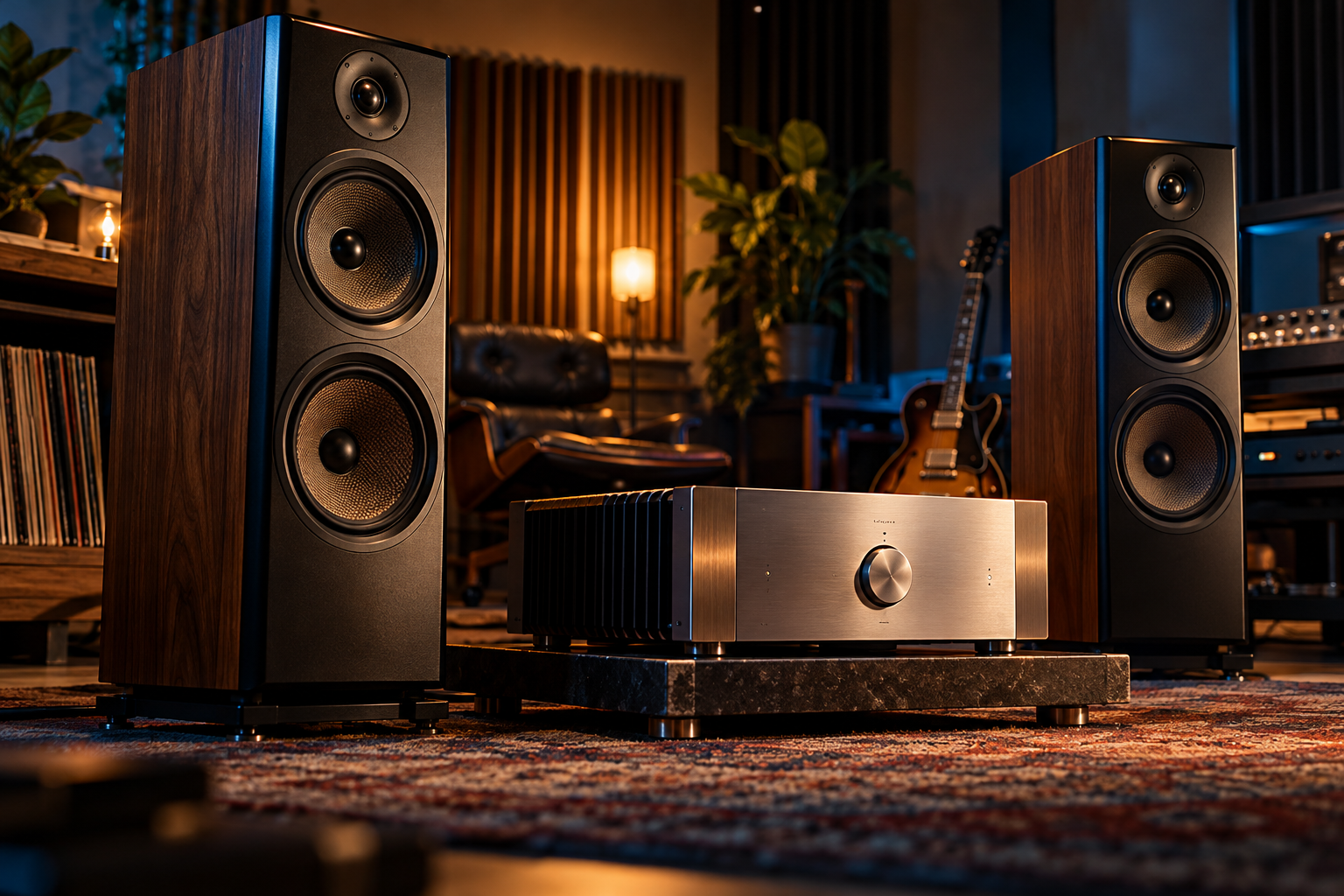
The complaint usually arrives the same way: the left channel sounds thin below 100 Hz, and the owner assumes the amplifier is underpowered. Nine times out of ten the amp has plenty of watts. What it doesn’t have is current delivery into the load, because the speaker’s impedance curve drops to 3.2 ohms right where the music lives. Buying a bigger amp is the expensive answer. Matching the amp to the dip is the correct one.
Let me walk through what I actually check before I quote a client anything.
Read the impedance curve before you read the wattage on the box
A nominal 4-ohm speaker is rarely 4 ohms. The spec sheet number is an average, and the average lies. Most two-way bookshelves I measure sit near 8 ohms through the midband, dip to 3 to 4 ohms in the upper bass, then climb back toward 10-12 ohms at the crossover and above.
The dip matters because it sits in the region where the amplifier is already working hardest. Bass content carries the most energy. If the impedance sags to 3.2 ohms at 80 Hz, the amp delivers nearly double the current it would into 8 ohms for the same voltage swing. That’s power supply stress, not output transistor stress, in most designs.
So the first thing I want is the actual impedance sweep, not the marketing number. Manufacturers who supply one (Revel, KEF, ATC, and a handful of others) get my respect. The rest I measure myself or ask the owner to accept the risk.
Why the dip is harder than the number suggests
Impedance is only half the problem. Phase angle is the other half. A load that is 4 ohms with a 0-degree phase angle is easy. A load that is 4 ohms with a -60 degree phase angle into the bass is brutal, because the amp must deliver current and voltage out of step. Some designs that claim 200 watts into 8 ohms will shut down into that combination at moderate volume.
The classic EPDR (equivalent peak dissipation resistance) figure combines the two. When I see a speaker that dips to 3.5 ohms at 85 Hz with a -50 degree phase angle, I know I need an amp with a genuinely stiff supply, not one that triples its 8-ohm rating only on a test bench.
The amplifier specs that actually predict behavior into a dip
Ignore the single 8-ohm wattage number. Look at these instead.
- 4-ohm rating doubling from 8 ohms. An amp that does 100 watts into 8 ohms and 200 into 4 ohms has a supply that can maintain voltage under load. One that does 100 into 8 and 130 into 4 is voltage-limited and will run out of current into the dip.
- Power supply capacitance and transformer size. A 500 VA transformer with 40,000 µF per rail is a different animal from a 200 VA transformer with 10,000 µF. This is where budget amps hide their compromises, and it shows up as compression on bass transients, not as distortion.
- Stability into reactive loads. Class D designs vary enormously here. Some have output filters that interact poorly with a 3-ohm load above 10 kHz; you don’t hear it as instability, you hear it as a slightly recessed top end and uneven tonal balance between quiet and loud passages.
- Protection behavior. A good amp limits gracefully. A bad one clicks off and back on during a bass drop. If the owner reports “sometimes the left channel cuts out for a second,” the amp is protecting itself from the load, not failing.
I’d rather run a 60-watt class AB amp with a 300 VA transformer and a genuine 4-ohm rating into a 3.5-ohm speaker than a 200-watt class D amp with a 200 VA supply. The class AB will hold its tonal balance at 90 dB SPL. The bigger-rated amp will sound progressively leaner as you push it, because the supply voltage sags and the protection circuit nudges in.
The wattage trap
Here is the calculation that stops the “buy more watts” reflex. A speaker with 88 dB sensitivity at 1 watt over 1 meter needs roughly 2 watts to hit 91 dB at the listening seat, assuming 3 meters and reasonable room gain. Peaks 20 dB above that (a realistic transient headroom target for uncompressed material) need about 200 watts peak into the nominal load. Into a 3.2-ohm dip, the voltage demand doesn’t change, only the current does. Doubling the amp’s 8-ohm wattage from 100 to 200 buys you 3 dB of headroom, and often less into the dip because the bigger amp may be even more voltage-limited.
The dip is a current problem. Watts are a voltage-times-current number. Buying voltage you don’t need is how you end up with a 250-watt amp that still sounds thin at 85 Hz.
What to actually do
Four moves, in order of cost.
1. Confirm the dip exists at the speaker terminals. Sine sweep with a multimeter, or a DATS/Woofer Tester if you have one. If the “4-ohm” speaker actually reads 5.5 ohms minimum, the whole conversation changes. One client had a speaker I’d have sworn was a hard load. It measured 5.8 ohms minimum with a gentle phase. His amp was fine; the issue was a room mode at 70 Hz that I found by moving the mic 40 cm.
2. Check the amp’s protection and bias. Older class AB amps with tired electrolytics in the supply can lose their 4-ohm capability without any visible sign. A recap on a 20-year-old amp often restores the current delivery the spec sheet originally promised. That’s cheaper than a new amp and it’s the honest fix more often than the industry admits.
3. If the amp genuinely can’t do it, pick the replacement by 4-ohm rating and supply size, not total watts. I’ve matched 3.5-ohm speakers with a 75-watt Rega, a 60-watt Naim, and a 100-watt Benchmark, all of which hold their ratings into 4 ohms. None of them are big-wattage amps by modern standards. All of them stayed composed on material where a 200-watt, 8-ohm-only receiver compressed.
4. Bi-amping or an active crossover is the last resort. Splitting the load so the bass driver gets its own amp removes the dip from the mid/treble amplifier’s working range. It’s real, it works, and it adds two more channels of gain structure to misconfigure. I only recommend it when the speaker is already wired for it or the owner is comfortable with a DSP crossover.
What I would not do
Don’t trust the “4-ohm compatible” sticker. Almost every amp on the market claims it. What matters is whether the manufacturer publishes a genuine 4-ohm power figure with the same distortion threshold as the 8-ohm number, and whether that figure shows meaningful current headroom.
Don’t assume an amplifier’s price predicts its behavior into a dip. I’ve measured $600 class D amps with stiffer supplies than some $3,000 tube designs. The topology and the transformer don’t care about the badge.
And don’t let a review of the speaker’s frequency response distract from what’s happening electrically. A driver that measures a mild dip around 70 to 80 Hz on-axis (a common shape for small two-ways) tells you nothing about the impedance. Those are two separate measurements and they matter for different reasons. The frequency response shape is what you hear. The impedance dip is what the amp has to survive.
In practice, the “thin bass” complaint gets solved by a competent 50-75 watt amp with an honest 4-ohm rating more often than by a 200-watt amp with an optimistic spec sheet. The dip isn’t a power problem. It’s a current problem wearing a power problem’s clothes. Match the amp to the load, and the complaint usually goes away without a single extra watt.